






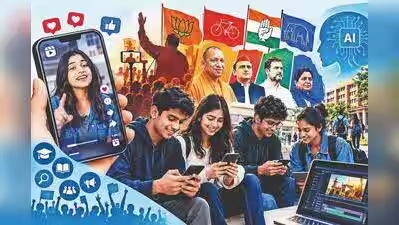
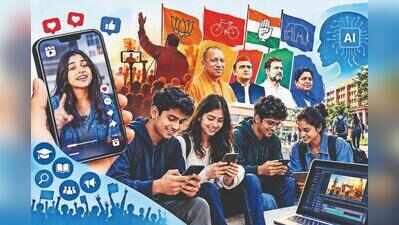
Lucknow: The 2027 Uttar Pradesh assembly election will be fought as much on screens and social media feeds as on the ground — with parties looking for new ways to turn digital engagement into political outreach and capture the attention of young voters who consume politics on phones and engage with issues in different ways.From hiring popular content creators and weaving political messaging into short-form videos to experiment with AI and taking campaigns to schools and colleges, parties are reworking their outreach to court Gen Z — and, increasingly, Gen Alpha.The contest is not just for votes, but for attention in an online ecosystem where a one-minute reel can travel faster than a conventional political message.Political experts say the push comes as issues such as examinations, recruitment, unemployment, education and infrastructure have increasingly featured in youth-led protests and public debates.For political parties, these concerns offer both a challenge and an opportunity: to speak to younger voters in the language and formats they consume while attempting to shape the issues that dominate their conversations.The BJP has begun building an extensive youth-focused digital outreach, combining influencer-led campaigns with AI initiatives and direct engagement in educational institutions.The Samajwadi Party and Congress are also exploring technology, social media and influencers to counter the BJP’s digital presence, while the BSP has asked its organisation to pay special attention to issues concerning Gen Z and Gen Alpha.For the BJP, the strategy combines digital creators who already command large audiences with more direct engagement in schools and colleges.“To tap Gen Z and Gen Alpha, we are planning hackathons on AI. As part of our campaign, we also organised school championships on Tiranga in Aug,” BJP IT and social media head Himanshu Raj Pandit told TOI. “To connect with youngsters, youth leaders will connect with youngsters in colleges,” he added.The party has started organising dedicated Gen Z outreach in Uttar Pradesh, including plans for youth teams to engage students directly in schools and colleges.Opposition parties are also exploring innovative ways to counter the BJP’s outreach and connect with a wider audience. “As of now, the SP is only responding to the BJP’s malicious campaign. In the days to come, the SP’s campaign team plans to explore innovative uses of technology, including AI, to make our outreach impactful,” said an SP functionary associated with campaign management.The party also has specific plans to reach out to Gen Z. Besides incorporating bits of Gen Z lingo in campaign videos, the SP plans to focus on issues and topics that are of particular interest to younger voters.Talking to TOI, Congress spokesperson Anshu Awasthi acknowledged that the party plans to tap social media influencers as part of its campaign strategy ahead of the high-voltage Uttar Pradesh elections.“We will take the help of influencers, but only those with creative acumen. Instead of a negative campaign like that of the BJP, our focus will be on highlighting the real issues concerning people, especially Gen Z. Our leader Rahul Gandhi has already been highlighting real issues during the ‘Bharat Jodo Yatra’ and ‘Chhatron Ki Goonj’ events,” Awasthi said.On the challenges posed by the use of AI in elections, particularly its potential to target opposition parties, Awasthi said the Congress would also use AI as part of its campaign but would draw a line between its use and misuse.The problems faced by Gen Z and Gen Alpha are as much a part of BSP’s election campaign in Uttar Pradesh as those faced by any other sections of voters. In the all-India meeting of the party in Lucknow on Sept 23, Mayawati asked the party cadre to specially focus on issues concerning Gen Z and Gen Alpha while reaching out to voters in the state.INFLUENCER ROUTEAlongside its grassroots outreach, political parties are looking at influencers who can carry political and govt messaging into highly engaged digital communities.Harshvardhan Patel, who runs the Instagram handle ‘ayodhyawale’, and has 2.1 million followers, said: “The govt is connecting with influencers like me to promote important events and public welfare schemes. The reels are to the point, with a duration of 1-2 minutes.”Ashutosh Mishra, who runs ‘lucknow_shehar’ Instagram page with 1,86,000 followers, said political and govt campaigns were among the promotional assignments handled by influencers.“BJP hires us for promotion, from welfare schemes to its campaigns. One reel is generally of one-minute duration, and we charge around Rs 15,000 for a reel,” he said.Alok Shrivastav, who runs ‘ishq_e_lucknowi’ Instagram handle with 2,16,000 followers, said, “We often run promotional campaigns through reels. I am in talks with the ruling party for the 2027 elections. Things are being worked out. Nothing is final yet.”The accounts offer the party a route to audiences that may not routinely follow conventional political communication. Research into political-influencer engagement during the 2024 Lok Sabha election cycle found that politicians were increasingly using digital creators as an alternative route to reach audiences, with political content often generating stronger engagement on digital channels than on mainstream media YouTube channels.AI & POLLS: BALANCING INNOVATION & INTEGRITYAs AI rapidly reshapes governance, electoral institutions face a critical inflection point. ‘The International Symposium on AI and Elections: Innovation, Integrity and Institutional Preparedness’, convened by the India International Institute of Democracy and Election Management (IIIDEM) on Feb 20, 2026, examined the opportunities and challenges for Election Management Bodies (EMBs).Held under India’s chairship of International IDEA and aligned with the India-AI Impact Summit 2026, the symposium focused on ensuring technological advancement reinforces democratic values. Its discussions built on the India International Conference on Democracy and Election Management (IICDEM) 2026, where the global thematic workstream on AI and elections was launched.IIIDEM director general Rakesh Kumar Verma called for a human-centred approach to AI that expands access and strengthens participation, particularly for marginalised communities.The discussions also highlighted risks including misinformation and AI-generated deepfakes, algorithmic bias, cybersecurity vulnerabilities, opaque automated systems, dependence on external technology ecosystems and uneven access to expertise, all of which can affect voter confidence, transparency, accountability and institutional autonomy.FROM CREATORS TO CAMPAIGN PARTNERSThe BJP’s engagement with creators is not new. In 2024, several BJP functionaries and Union ministers appeared in interviews and informal conversations with digital creators. One prominent example was then Union minister Nitin Gadkari’s appearance on food and travel influencer Kamiya Jani’s Curly Tales channel.The broader trend was documented during the 2024 Lok Sabha campaign, when political parties increasingly turned to influencers to reach younger digital audiences.The Centre also launched the National Creators Award in 2024, recognising digital creators across categories including storytelling, social change, education, gaming and technology. Prime Minister Narendra Modi presented the first award in March that year.The political-influencer relationship, however, is not limited to promotional reels. Researchers studying politicians’ engagement with YouTube creators have pointed to the appeal of informal interviews, where politicians can present a more personal image and reach audiences beyond conventional news consumption.