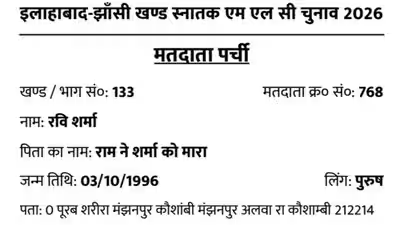









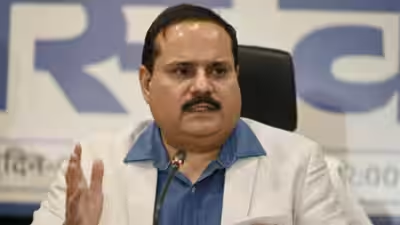
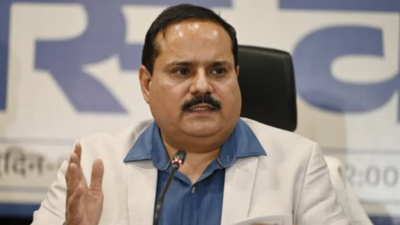
LUCKNOW: A day after TOI exposed bizarre names and parental details in the electoral rolls of Uttar Pradesh Legislative Council’s Graduates’ constituencies, Chief Electoral Officer (CEO) Navdeep Rinwa on Thursday said fewer than 150 voters had been identified with incorrectly printed names or parental details among 14.81 lakh registered electors, accounting for less than 0.01% of the electorate.Defending the newly introduced online electoral roll preparation system, Rinwa said that for the first time in Uttar Pradesh’s history, the entire process of preparing electoral rolls for Graduates’ and Teachers’ constituencies had been conducted digitally, replacing the earlier district-level manual system.According to the CEO, the online platform was developed by the election office’s IT team with technical assistance within four months, incorporating voter registration, application processing, approval, rejection, duplication checks, serialisation and electoral roll downloads.The clarification came after TOI reported several unusual entries in the Allahabad-Jhansi Graduates’ constituency electoral roll, including a voter named Ravi Sharma whose father’s name was recorded as “Ram Ne Sharma Ko Mara”, another named “Ram Ne Yadav Ko Mara”, and Narendra Yadav, whose father’s name appeared as “B Com”.Other peculiar entries included Faiz Abbas Ne Kaha, son of Syed Jabbar Hussain, and Irfan Ali Ne Kaha, son of Syed Irfan Ali.The list also featured Murkh Kali Devi, whose father’s name was recorded as Ramjeet Patel, despite the voter being classified as male. Another entry identified Mohammad Pagal Rehan, son of Mohammad Hashim, while a voter named Takkar Marna had the same words recorded as his father’s name.Rinwa said reports received from districts indicated that fewer than 150 electors had errors in their names or relatives’ names. He described the proportion as extremely small compared with the total electorate.Explaining the digitisation exercise, the CEO said the Election Commission’s Sept 5, 2016 instructions had envisaged online registration facilities for eligible applicants.The portal, launched on Oct 1, 2025, allowed applicants to submit registration forms from home. Based on the Nov 1, 2025 qualifying date, 3,43,355 applicants registered online, comprising 2,91,273 Graduates’ constituency applicants and 52,082 Teachers’ constituency applicants.The final electoral roll was published online on Jan 6, 2026, and uploaded to district election officers’ websites.Subsequently, applications for additions, deletions and corrections were processed monthly through supplementary electoral rolls, which were also uploaded online and shared with recognised political parties.Earlier, supplementary rolls were not available online, making it difficult for voters and political parties to track changes.Following disposal of pending applications before the election announcement, the final electorate across the Graduates’ and Teachers’ constituencies stood at 14,81,310 voters.Rinwa said another facility enabled voters to identify their polling stations and electoral roll serial numbers from home by entering their name or a relative’s name along with the mobile number provided during registration.He acknowledged that officials and operators were using the newly developed system for the first time and had undergone training.However, the CEO’s statement did not explain how the unusual entries identified by TOI passed verification or whether the errors originated in applications, data entry or subsequent processing.Meanwhile, Rinwa directed election officials to ensure that no eligible voter is denied voting rights due to clerical or printing errors during Friday’s polling.During a virtual meeting with returning officers, divisional commissioners, district election officers and electoral registration officers, Rinwa acknowledged receiving complaints from political parties and through social media regarding errors in voters’ names and their relatives’ names.