











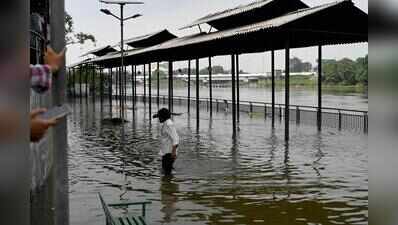
Lucknow: After keeping several low-lying parts of Lucknow inundated for nearly two weeks, Gomti is expected to begin receding from Thursday as water levels at key upstream gauge stations have started falling, signalling that the flood wave triggered by exceptionally heavy rainfall in the upper catchment has largely passed the state capital.Though the river continued to show a marginal rise in Lucknow through Wednesday, irrigation department officials said the increase was due to delayed upstream runoff reaching the city rather than fresh rainfall in or around Lucknow.According to Central Water Commission, Gomti at Hanuman Setu was recorded at 107.20 metres at 10 am on Wednesday, up slightly from 107.18 metres at 8 am.By 9 pm, the river had risen another 5 cm to 107.25 metres and remained nearly stagnant at that level at the time of filing this report.The river stayed well below the warning level of 108.50 metres and the danger mark of 109.50 metres. It was also far from Lucknow’s highest recorded flood level of 110.85 metres, registered on Sept 10, 1971.Upstream data, however, showed a clear reversal in trend. At Neemsar, around 90 km upstream of Lucknow and located just before Kathina tributary joins Gomti, the river had peaked at 122.02 metres on Sept 29. By 10 pm on Wednesday it had declined to 121.7 metres, with officials noting a current falling rate of about 1 cm per hour.A similar decline was recorded at Bhatpurvaghat, roughly 40 km upstream of Lucknow and situated before Sarayan merges with Gomti. The level there fell from a recent high of 113.16 metres on Oct 2 to 113.08 metres by 10 pm on Wednesday, with the river dropping at around 1 cm every two hours.“By Thursday morning we are expecting that Gomti river water in Lucknow will start receding,” said Anil Garg, principal secretary, irrigation department.Officials estimate that the river is currently carrying about 25,000 cusecs in Lucknow, compared to Gomti barrage’s design capacity of 1.25 lakh cusecs. Historical comparisons underline that this year’s water levels are not being driven by extreme discharge alone. During the record 1971 flood, nearly 1.07 lakh cusecs passed through the barrage when the river touched 110.85 metres. In 1985, when the river reached the danger mark of 109.50 metres, discharge was estimated at around 74,000 cusecs.Irrigation department officials said the prolonged inundation in several neighbourhoods is the result of multiple factors acting together, including encroachment on natural floodplains by residential development, sustained upstream inflows over many days, the vulnerability of low-lying settlements, and inadequate drainage that slows the evacuation of accumulated water.“We must also consider that numerous residential colonies and other structures have come up on the Gomti floodplain over the years. These obstructions restrict the river’s natural ability to spread across its floodplain during high flows, forcing water levels to rise higher within the channel. Under natural conditions, the river would disperse over the floodplain instead of remaining confined,” an irrigation department official said.He cited the 2008 flood as an example of how urban expansion has changed flood impacts. “In 2008, when the river had touched 108.06 m at Gomti barrage with 42,000 cusec of water, the area up to Vipul Khand was inundated. Today, localities much closer to Gomti such as Faizullaganj, Daud Nagar, Ghaila and adjoining colonies are facing enormous accumulation of floodwater and will drain back into the Gomti river only after the river level starts falling,” he said.