








Advanced aerial technology combines surveillance, night lighting and public announcements, while carrying relief supplies to areas cut off by floodwater
Editors’ Desk | Lucknow
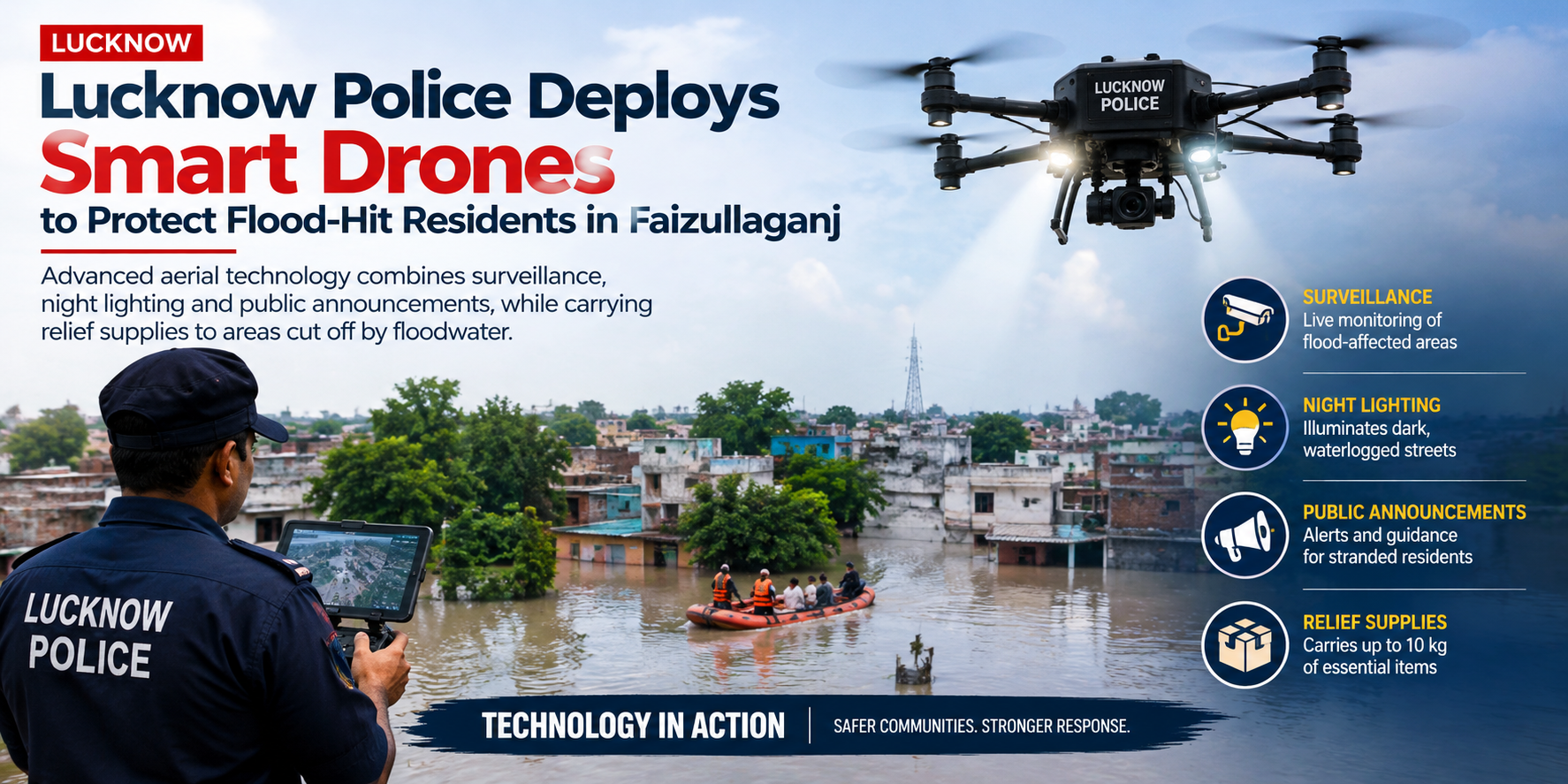
LUCKNOW, October 10: In a technology-driven response to the ongoing flood crisis, Lucknow Police has deployed a multifunctional drone in Faizullaganj to strengthen security, support relief efforts and assist residents stranded by rising floodwater.
With several lanes submerged and families forced to leave their homes, conventional police patrolling has become increasingly difficult. The newly deployed drone is helping authorities monitor inaccessible areas, illuminate waterlogged streets and communicate emergency messages to people trapped inside their homes. <Cite refs={[“turn566927view0”]}/>
One Drone, Three Critical Functions
The Modular Aerial Policing Drone (MAPD), deployed in collaboration with Delhi-based robotics startup Aevon Dynamics, integrates three key functions into a single aerial platform: lighting, live surveillance and public communication.
Its lighting system illuminates dark, waterlogged streets, while an onboard camera transmits live footage to the police control room. A public address system allows officers to broadcast emergency information and instructions to residents in areas where access on foot is difficult.
The drone is designed to help police maintain a visible presence in affected neighbourhoods, particularly after dark, when movement becomes more challenging and evacuated homes may be vulnerable to theft.
Emergency Messages Reach Residents Trapped Indoors
As the drone flies over flooded streets, it broadcasts messages reminding residents that police assistance is available.
“UP Police is here to help you. Dial 112 in case of any emergency,” the announcement tells residents.
Deputy Commissioner of Police (North) Amit K Anand said the announcements are intended not only to provide emergency information but also to reassure residents who may feel isolated amid darkness and flooding.
The live aerial feed also enables police personnel to monitor rooftops, narrow lanes and flooded compounds, helping them assess ground conditions and coordinate assistance more effectively.
Drone Can Carry Up to 10 Kg of Relief Supplies
Beyond surveillance and communication, the drone can transport up to 10 kg of essential supplies to locations that are difficult to reach on foot.
Once the drone helps identify residents in need, police personnel can use boats to reach affected families, deliver supplies and support rescue operations.
According to Aevon Dynamics founder Yawar Sayeed, the system has been developed around the combined capabilities of light, vision and communication, allowing police to perform several tasks through one aerial platform.
The system’s concept note states that its lighting module can illuminate approximately 400 square metres, while its speaker system can cover around 2,500 square metres.
Technology Strengthens Flood Response
The deployment marks an innovative approach to policing during a natural disaster, when conventional methods of surveillance and public communication face significant limitations.
DCP North, who is overseeing the police response in the affected area, said the initiative forms part of broader efforts to maintain surveillance and assist residents in flood-hit pockets where movement remains restricted.
Aevon Dynamics has reportedly been working with Uttar Pradesh Police on drone technology for about a year.
The company is also developing a separate drone intended to lift a person weighing up to 100 kg. However, that project remains in development and is not the same as the drone currently being used for flood relief.
A New Direction for Disaster Management
The use of multifunctional drones in Faizullaganj highlights how emerging technology can support emergency services when roads and residential lanes become inaccessible.
By combining aerial monitoring, emergency announcements, lighting and limited supply transport, the system offers police an additional tool to identify vulnerable residents and coordinate assistance.
However, technology alone cannot resolve the challenges posed by widespread flooding. Timely rescue operations, safe drinking water, electricity restoration, medical assistance and effective drainage remain essential to helping affected families recover.