










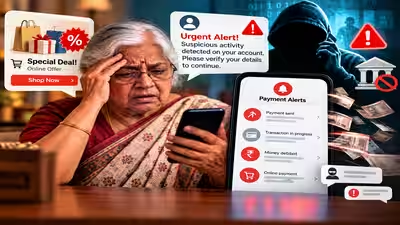
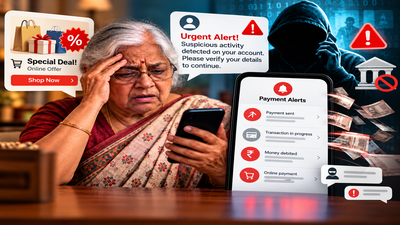
A 79-year-old woman in Mumbai recently tried to buy dry fruits worth Rs 248 after seeing an advertisement on WhatsApp. Instead, she lost Rs 11.7 lakh after a caller posing as a company representative persuaded her to make 13 UPI transfers. She was warned that her bank account could be closed due to a technical error.Her experience brings together several findings in the GSMA India Consumer Scam Report 2026, based on an online, English-language survey of about 500 Indian adults conducted from July 29 to August 3. Online shopping scams were cited by 33% of Indian victims, more than any other type. Among surveyed victims who lost money, two in three recovered nothing.The survey compares Indian respondents with those in Singapore, Malaysia, Thailand, Indonesia, the Philippines and Vietnam. Three in four Indians surveyed (75%) said they were very concerned about online data privacy, against 48% across those six countries. Yet two in three (66%) were comfortable sharing personal details with “conversational apps” when buying, against 40% across the region. A third (33%) said they were “very comfortable” doing so, against just 7%. The report does not name the apps or establish whether respondents actually shared their details.
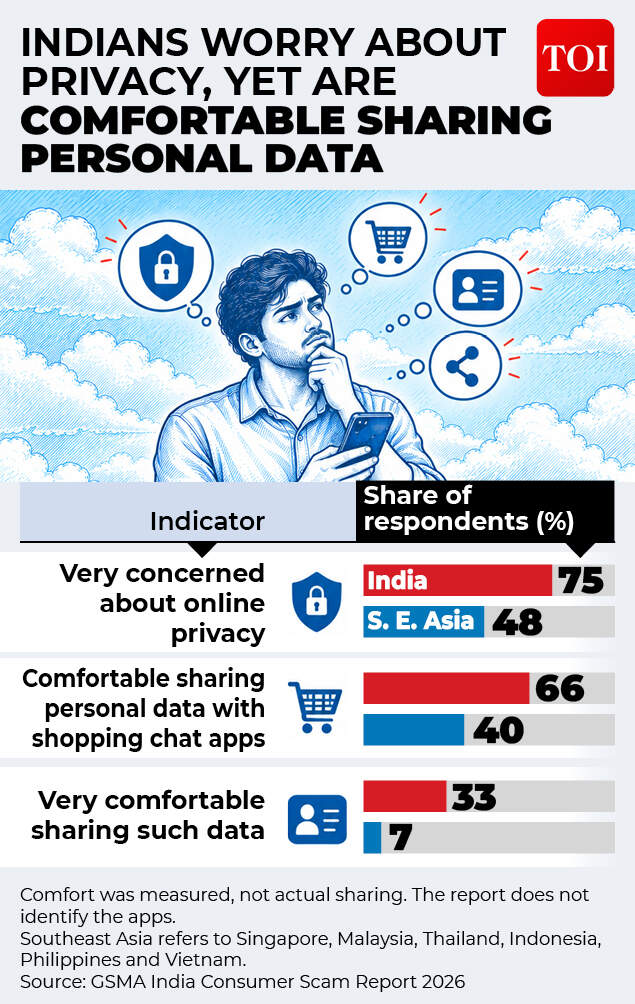
Privacy fears high, but Indians willing to share data
Trusting the channels scammers use
Indians also rate everyday communication channels as more trustworthy than respondents in the six Southeast Asian countries. These are also channels regularly used by scammers. Among Indian victims, 42% were scammed through messaging apps, 37% through social media and 33% through email. The email figure is almost double the regional 17%. And 64% of Indian victims were scammed through multiple channels, against 43% across the Southeast Asian countries.
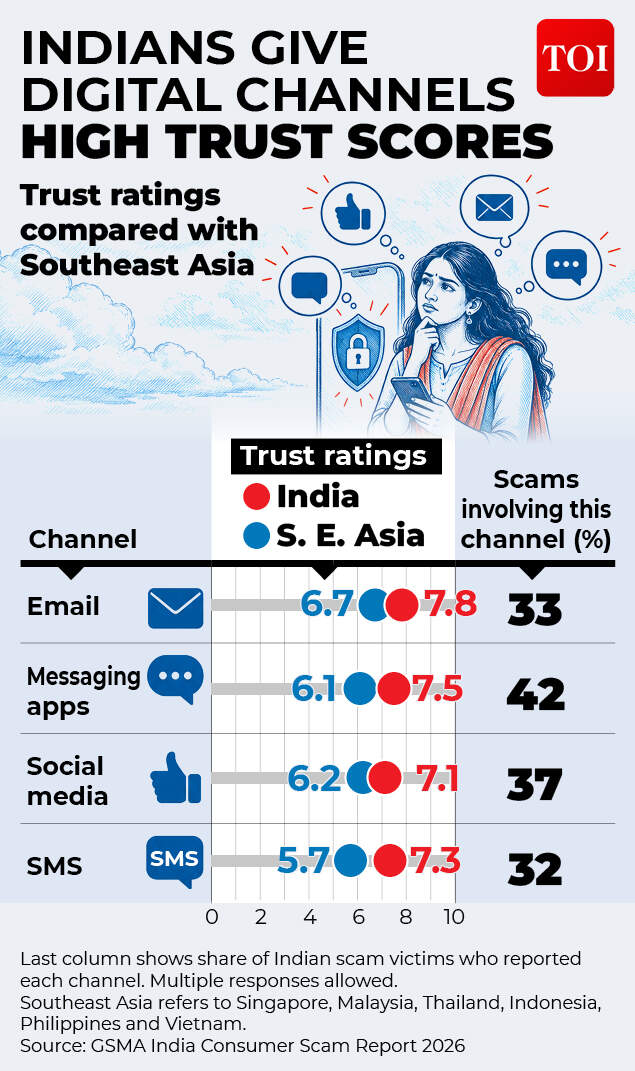
Messaging apps lead scam routes, with 42% exposure
After online shopping, prize, lottery or inheritance scams were cited by 31% of Indian victims (remember the Nigerian prince emails?), and job or income scams by 30%. QR-code or payment-link scams were cited by 27%, against 18% across the region.Scammers also apply psychological pressure. Urgency featured in 39% of Indian victims’ experiences, while secrecy or confidentiality featured in 33%, against a regional average of 22% for secrecy. In the Mumbai case, the alleged fraudster created a fear of losing banking access by warning that a technical problem could lead to account closure. Digital-arrest scams often play on the secrecy angle by leveraging potentially sensitive information.Technology adds another layer. Nearly half of Indian respondents (48%) said they had encountered AI-written scam messages, the same share reported fake AI images, and 42% said they had seen deepfake videos of real people.
The changing behaviour pattern
Indians are gradually becoming more guarded against scams. Seventy-two per cent of Indian respondents said their own experience, or that of someone close to them, had changed how they behave. Sixty-one per cent avoided some incoming contacts or online transactions because of scam concerns, and 26% had cut back on or changed how they shop online, up from 20% in 2025.There is healthy scepticism about platforms too. Sixty per cent associated Facebook with scams, up from 51% in 2025, and Instagram’s figure rose from 50% to 57%.But only 49% had strengthened their account security, against 58% across the region. Among victims, 93% said that, in hindsight, they had done something they should not have, and 91% felt confident they would not fall for a similar scam again.Indians are relatively willing to let institutions use their data to detect fraud. Of the respondents, 87% were comfortable with banks or financial providers doing so, 82% with the government, 81% with mobile operators and 73% with digital platforms, each higher than the corresponding regional figure.
Recovering losses is difficult
Twelve per cent of Indian respondents said they had been scammed in the previous year, against 8% across the region. Of the 165 Indian respondents who had ever been scammed, 86% approached at least one organisation, against 69% across the region. The share going to the police rose from 37% in the 2025 survey to 49%.However, a third of reported cases remained unresolved, and in 35%, no organisation took primary responsibility in the victim’s experience. Among those who lost money, 67% recovered nothing. India’s recovery outcome was nevertheless better than the six-country average. Some 33% recovered some or all of their money, against 18% across the region.
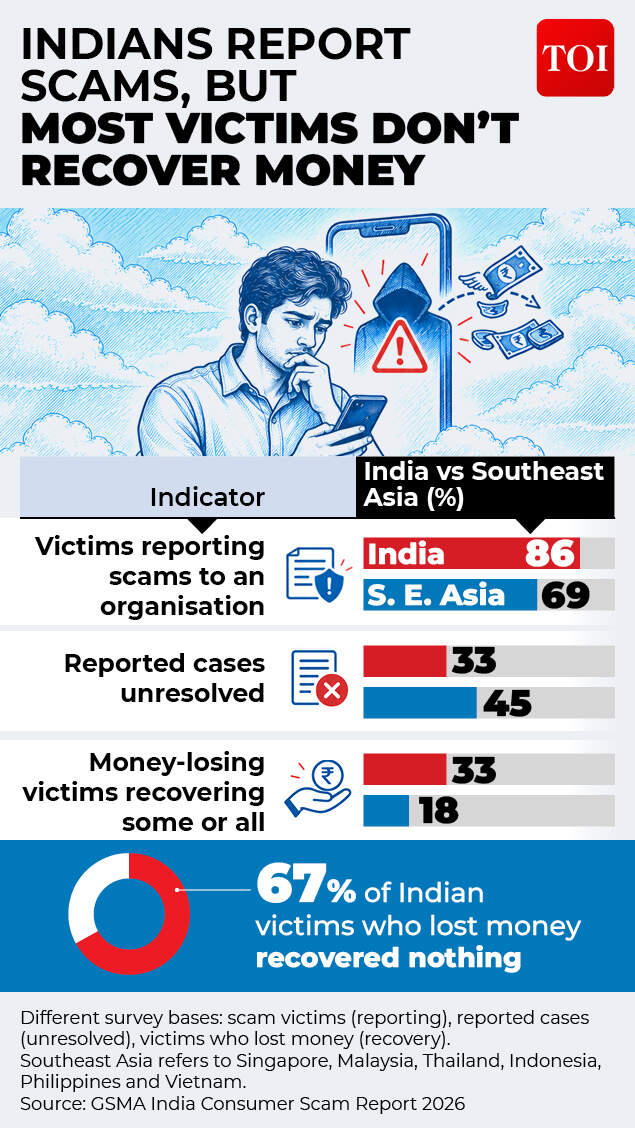
India’s record is better than countries in Southeast Asia
The home ministry told Parliament that the Citizen Financial Cyber Fraud Reporting and Management System had “saved” more than Rs 11,158 crore across over 32.80 lakh complaints by June 30, 2026, but that figure does not show how much victims got back. In a separate disclosure, the ministry reported more than Rs 206 crore refunded over the three financial years from 2023-24 to 2025-26. The National Crime Records Bureau does not maintain data on money lost or recovered in cyber fraud cases, Rajya Sabha was informed.
Scam, a global menace
GSMA, which represents mobile operators, calls for closer coordination among banks, platforms, telecom companies and authorities after scams are reported, and for greater transparency from government and police.Scams are a global business. The Global Anti-Scam Alliance estimates that consumers across 42 surveyed markets lost about $442 billion to scams in a year. In the US, the FBI recorded $20.877 billion in cybercrime losses in 2025, more than $2.9 billion of it from two forms of call-centre fraud: fake tech support and government impersonation. The FBI’s 2025 Internet Crime Report recorded 5,879 complaints from India, the second-highest among countries outside the US, after Canada.
Share your thoughts in the comments
Be respectful · TOI community guidelines
Since 2022, the FBI and CBI have run 27 joint operations against such fraud in India, leading to more than 475 arrests. One of them, Operation Chakra, broke up a Noida-based network in December 2025 accused of duping more than 600 Americans of over $48.7 million.If you are conned, call 1930 immediately. It may help save your money.