








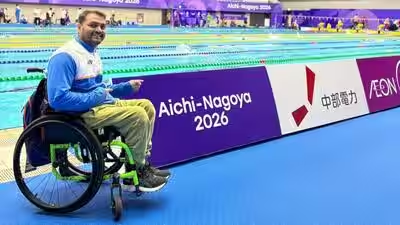
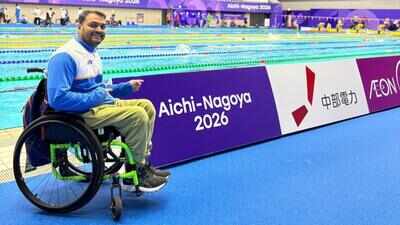
Kolkata: Bihar’s Shams Alam will create history at Asian Para Games in Japan, becoming the first para-swimmer from the state to compete at three consecutive editions.But after months of disrupted training, a burn injury and prolonged selection uncertainty, the wheelchair-bound swimmer arrives in Nagoya with a modest target: a top-six finish in the 100m breaststroke and an improved timing.“Ever since the last Para Asian Games, my target was to go to the next edition in Japan and win a medal. I had started preparing from that time itself,” Alam told STOI from Nagoya.His qualification campaign gathered pace in 2025, when he secured the qualifying mark at an international competition in Iceland, improved his timing in Barcelona in March and went faster again at the national meet in Oct.Alam’s preparations, however, suffered a major setback around Feb-March this year when he was removed from the Sports Authority of India (SAI) training centre in Gandhinagar.“Suddenly being removed from there was a very big shock. I was preparing for a competition in Norway in March-April, where I wanted to improve my ranking further. I had no other option but to return to my village (Rathaus in Madhubani district of Bihar) because I had nowhere else to stay, and I lost valuable training time,” he said.He later shifted to Delhi, resumed training and returned to international action in Sweden in May, significantly improving his timing and finishing among the top five.Another setback followed when a hot pad used to ease back pain caused a burn injury. Alam, who has a spinal cord injury, lacks sensation in the affected area and did not immediately realise the severity of the burn. The wound took around two to two-and-a-half weeks to heal, disrupting his preparations for the June trials.“I did not realise how badly my skin had burned because I could not feel it. I even went swimming before the lifeguards noticed the injury,” he said.Although he could not reproduce his performance from Sweden at the trials, his timing and ranking were sufficient for selection. The uncertainty, however, continued for months, with the final team announcement arriving after a prolonged wait.“The lack of clarity mentally disturbs us. We cannot decide what to focus on — our practice or the paperwork and requests needed to get answers. If selection decisions are communicated within a proper timeline, athletes can prepare much better,” Alam said.The travel arrangements added to his difficulties. Tickets to Delhi arrived late on Tuesday, followed by a journey through Singapore and Tokyo before the contingent reached Nagoya on Thursday.In Japan, Alam is also struggling without an escort despite being a wheelchair user. He said the carpets in his hotel make wheelchair movement difficult, causing shoulder pain, while the swimming venue is about one-and-a-half hours away. The exhausting commute has restricted training to one session a day instead of the usual two.“I have officially requested help because continuously moving the wheelchair makes my shoulders hurt badly, and that affects my performance. According to World Para Swimming guidelines, an escort is compulsory in my category,” he said.Alam qualified in three events — the 200m individual medley, 100m breaststroke and 200m freestyle — but will compete only in the breaststroke on the coaches’ advice. However, he later found that just four swimmers had entered the individual medley, an event in which he believes he could have had a medal opportunity.In the breaststroke, he faces strong competition from swimmers from Malaysia and Kazakhstan, besides Indian teammate Rohit Kumar. “Realistically, a medal may be beyond me here. My aim is to finish in the top six, improve my timing and avoid disqualification in this technical event,” he said.For Alam, the third successive appearance is already a landmark for Bihar. In Japan, he hopes to build on that achievement and take another step towards qualifying for the upcoming World Championships.