








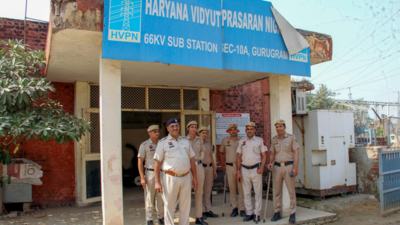
GURGAON: A three-day strike called by electricity department employees in Haryana to oppose a parallel distribution licences granted to Eleven Power for Gurgaon and Nuh caused widespread power supply disruption in Millennium City and hit industrial operations.All India Power Engineers Federation chairman Shailendra Dubey on Thursday urged the state to revoke the licence using its statutory powers under Electricity Act, 2003 and called for a cabinet decision ruling out parallel distribution licences in Haryana.Energy minister Anil Vij, however, termed the strike unnecessary, saying govt had opposed the move before Haryana Electricity Regulatory Commission (HERC) and would also file an appeal at Appellate Tribunal for Electricity (APTEL). He urged employees to resume work and join the legal fight.Power faults went unattended and helplines remained unanswered as outages stretched for hours across Gurgaon on Thursday, affecting more than 50,000 households in Old Gurgaon on a weekday.Dakshin Haryana Bijli Vitran Nigam (DHBVN) received around 5,000 outage complaints through its helplines, but residents alleged they got no satisfactory response. With supply yet to be restored in several localities, residents said they feared the situation could worsen on Friday and Saturday.Employees are protesting the move, saying it threatens the existing public distribution system.In Zara Aavaas, an affordable housing society, residents said power had been out since 5.30am. The society’s backup covers only essential services such as lifts and is not available for individual flats.“On one hand, pollution levels are increasing and GRAP restrictions are in place, while on the other, the prolonged power outage has forced people to run diesel gensets. Many residents have to work from home, but how are they supposed to work without electricity for so many hours? It is even more difficult for people with medical conditions who may depend on electrical equipment or need a comfortable indoor environment,” said Hemant Sharma, a resident.Minister Vij said the govt had not invited applications for privatising electricity distribution, but central law allows any eligible person or company to apply for a distribution licence. “I am against privatisation because substantial public money has been invested in the infrastructure and employees’ jobs are at stake,” he said.As outages dragged on, residents said their biggest concern was the uncertainty over when power would be restored. Many said they had been forced to manage without electricity through the day and prepare for another possible disruption.“There has been no power supply since 5am. It has become difficult to manage even basic household chores. Even inverter ran out of battery and I had to cook dinner using the light from my mobile phone. We don’t even know when the electricity will be restored. The management has asked residents to move to the community hall, but while we somehow managed today, we don’t know what will happen tomorrow if the power supply remains disrupted,” said Anu Gulati, a resident of Lotus Homz.Residents of Rajendra Park, Bhimgarh Kheri and areas near Gurgaon railway station staged a protest near the railway station road bridge on Thursday evening, after being without electricity since 10am. By around 8pm, with the outage stretching to nearly 10 hours, a large number of men and women took to the road and raised slogans against the power department. Police personnel were present to pacify them, but residents refused to disperse until power was restored. They said the outage had made it difficult to manage household chores and had also disrupted water supply. “There is no electricity, and there is no water in our homes. How are we supposed to run the water motor without power?” said Rupa, a resident.In DHBVN’s Circle 1, 12 of the 530 11kV feeders were out of service. In Circle 2, 14 of the 750 feeders were shut down. Gurgaon has around 8.5 lakh electricity consumers.Circle 1, which covers Old Gurgaon, sectors 9 and 10, and Kadipur, saw more widespread disruption. Circle 2, which includes parts of South City, Sohna and sectors along Golf Course Road, was less affected because line maintenance in some areas has been outsourced to a private company whose workers continued to attend to faults. The arrangement, however, covers only selected localities, while substations and powerhouses still depend on DHBVN staff.Power supply remained disrupted in nearly 50 localities, including Palam Vihar, New Palam Vihar, Sai Kunj, Chandan Vihar, Ashok Vihar, sectors 3, 4, 5, 6, 7 and 7 Extension, Hari Nagar, Gandhi Nagar, Rajendra Park, Vishnu Garden, Surat Nagar, Dhanwapur, Sushant Lok 2 and 3, Manesar, Sohna and Taoru.In Sector 9A, around 6,000 families were affected after supply snapped around 3.30am, residents said. In Sushant Lok 2, around 500 families in B block were without power from about 6am. Supply was restored in Sushant Lok around 2.30pm, but Sector 9A remained without power at the time of going to print.Four feeders at Sohna and Nimauth power houses were out of service by 8am on Thursday. The number rose to 12 by 3pm, affecting around 30 villages. Two urban feeders were also disrupted, hitting City-4, Gehlot Bihar and the MVN and Aekam residential societies.Officials said five of the 15 feeders serving rural areas and seven of the 39 urban feeders had been shut down by 3pm. DHBVN deployed around 100 workers hired through a contractor to repair faults, but the arrangement brought little relief as workers were reportedly unable to identify the faults.“About 98% of DHBVN’s officers and employees are on strike. Even executive engineers and superintending engineers have joined it. The absence of staff is making it difficult to address electricity complaints. Senior officials have been informed about the situation,” said chief engineer PK Chauhan.The scale of the agitation was reflected in staff participation across the city. In Circle 1, 816 of 826 employees joined the strike, while 540 of 557 employees in Circle 2 stayed away from work. Outsourced staff and workers recruited through Haryana Kaushal Rozgar Nigam also joined the protest.Superintending engineers Shyambir Saini and Manoj Yadav also supported the agitation.Subhash Kumar, SDO of Sohna DHBVN, said updates on outages were being shared with senior officials every hour.On Wednesday evening, deputy commissioner Uttam Singh issued a press release listing contact numbers for consumers facing outages. Residents, however, said complaints made through toll-free numbers 1912 and 180010804334, as well as WhatsApp numbers 8813999708 and 9540954768, did not result in timely relief.Vij said the dispute had to be fought in court because the licensing decision was taken by the regulator, not the state govt. He urged employee leaders to call off the strike and join the legal effort, offering them the option of advising the govt’s lawyer, appointing their own counsel or recommending another lawyer.Dubey, along with Haryana Power Engineers Association leaders Puneet Kundu and Ravinder Singh Ghanghas, called on chief minister Nayab Singh Saini to convene a cabinet meeting and announce a policy ruling out parallel distribution licences anywhere in Haryana.Employee union leaders questioned HERC’s decision, alleging it appeared to promote privatisation. They sought greater transparency on Eleven Power’s experience, technical capabilities, capital investment, financial strength and eligibility, along with public disclosure of the criteria used to assess its application. They also demanded an impartial inquiry into the roles of the regulator and the company.The leaders argued that parallel distribution licences could weaken the revenue base of public utilities in an agriculture-dominated state, potentially affecting farmers and ordinary consumers. Amarjeet Jakhar and Mukesh Bhayana said the agitation would continue until the decision was withdrawn. Jakhar said employees would decide whether to extend the strike beyond Oct 24 if their demands were not accepted.