










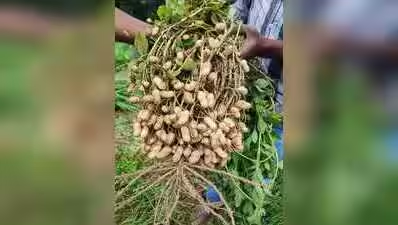
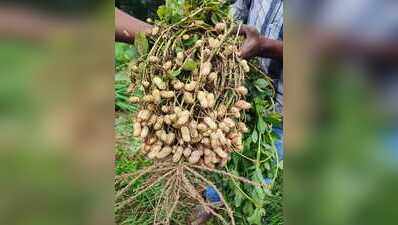
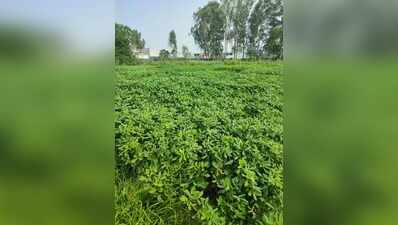
Ludhiana: As winter drives demand for groundnuts across Punjab, local markets remain dependent on supplies from Gujarat and Rajasthan, prompting Punjab Agricultural University (PAU) experts to advocate for a major revival of the crop to save water and boost farm incomes.Once a major staple covering 2.2 lakh hectares in 1968, groundnut cultivation in Punjab has collapsed by over 99% to just 1,600 hectares in 2023–24, yielding around 2.8 thousand tonnes with an average output of 7 quintals per acre.PAU extension scientists argue that farmers should capitalise on strong local and out-of-state demand currently met by other states, particularly in historical hubs like Mullanpur and Khanna.“There is a huge demand for groundnut in Punjab and elsewhere, but the demand is largely being met through supplies from other states. If Punjab farmers expand cultivation, they can cater to a market that is already there,” said Dr. Gurpreet Singh, extension scientist (oilseeds), PAU.The university is promoting groundnut as a low-water alternative to water-intensive spring maize, noting that spring groundnut saves 65 to 70 cm of irrigation water, requires significantly less urea, fixes nitrogen to improve soil health, and commands a higher minimum support price (MSP) than paddy.To drive adoption, PAU has recommended high-yield varieties: J 87 (confectionery-grade, yielding 15.3 quintals/acre in spring with 49% oil and high oleic acid), TG 37A (early-maturing), and SG 99 (tolerant to bud necrosis disease).Encouraged by successful trials, farmers in Hoshiarpur, Sangrur, and Kapurthala are expanding cultivation—with one Kapurthala farmer sowing 26 acres of J 87—while PAU has developed a tractor-mounted digger-shaker to solve harvesting labour shortages.