











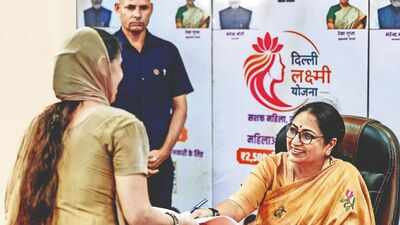
By: Kavya DubeyNEW DELHI: 52-year-old Uma, who lives in Harijan camp at Lodhi Road, is happy to know she will have something added to her savings every month, thanks to the Delhi Lakshmi Yojana.Her daughter has just started college, and Uma had been concerned about having enough funds for her wedding.For Priti (29), the monthly stipend of Rs 2,500 means only one thing – nurturing her 10-year-old daughter’s inclination towards studies. For the resident of Burari’s Nathupura in north Delhi, the vision of her family’s future is pegged on her child’s education.“She wants to be a teacher,” she proudly told TOI. And what does Priti want? “Bachchon ke baad, apni ichhayen khatam ho gayi (after my children were born, my desires ended),” she said, attending to her squealing three-year-old son.Sumitra (35), who lives near Kotla Mubarakpur, too, had long lived with a similar thought. Her life revolves around raising her sons, aged 15 and 13, and supporting her husband.But with the stipend she awaits, a wish buried beneath the weight of responsibilities quietly made its way to her heart once again.Sumitra wanted to learn tailoring. But a six-month course costs Rs 4,000-5,000.With her husband’s salary of Rs 20,000 a month, Sumitra’s home runs on a tight budget: Rs 5,000 for rent, about Rs 10,000 for food and groceries, and the remaining for her sons’ education and household expenses.But now, she is thinking beyond her home-bound roles – she wants to learn tailoring, start something of her own and contribute more to the household. “I would be very happy if she earns her own money,” said her husband, who works as a peon.During the 2025 assembly polls, BJP-led Delhi govt had announced it would grant Rs 2,500 monthly assistance to women from economically weaker families.The move aims to give such women greater financial security and the ability to make decisions independently, CM Rekha Gupta had said.
Some relief, but with income riders
According to economist Rajiv Kumar, chairperson, Pahle India Foundation and former vice-chairperson of Niti Aayog, while the scheme offers crucial savings for women, the income eligibility can exclude many.“Any additional income does provide some relief. But the criterion of family income being less than Rs 2.5 lakh annually is a bit tough – it implies a monthly income of less than Rs 21,000 per family or less than Rs 700 per day,” Kumar said, adding it implies per capita income of less than Rs 200 per day for a family of four.Kumar pointed out that as per official data tabled in March, Delhi’s per capita income was projected to be Rs 5.3 lakh for 2025-26. “We could have chosen a higher cut-off,” he noted.Anjali (38), a resident of Shidipura, Karol Bagh, earns Rs 7,000 a month packing pens and other articles in a godown close to her home. Her husband has neither a fixed job nor a fixed salary.However, despite her unstable resources, she is adept at managing her household, and the couple together plans a month ahead.“There are plenty of problems, but we face them and move on,” she said. The uncompromised expenditure in her household is her 15-year-old son’s school and tuition fee – Rs 2,000- 3,000 a month.Her “cooperative” septuagenarian in-laws, in whose house the entire family lives, offer her support and relief.
The inflation factor
For households in this income group which may not anticipate a rise in prices of essentials, how much does a welfare scheme like Lakshmi Yojana help?“Since Delhi has such a high average per capita income, the existence of a substantial population of families living on less than Rs 2.5 lakh a year is indicative of high inequality. This is a distributional issue,” said Shirin Akhter, associate professor of economics at DU’s Zakir Husain Delhi College.“Consider the recent increase in sugar prices. Govt data show that the all-India average retail price of sugar increased from around Rs 48 per kg in July to over Rs 65 by Aug 26. For a household living close to its subsistence constraint, such increases can require actual changes in consumption. The Rs 2,500 transfer consequently becomes significant,” she added.However, for the poorest households, “the expenditure is disproportionately concentrated in necessities”, Akhter said.“An important question here is: what does the family stop buying? If it is fruit, milk, pulses, today’s inflation becomes tomorrow’s nutritional deficit. If it is medicines, it becomes a health deficit. If it is tuition, books or schooling, it becomes a human-capital deficit. If the household borrows simply to maintain essential consumption, today’s inflation becomes tomorrow’s debt burden. And if women compensate by increasing paid work while continuing to carry unpaid household and care responsibilities, inflation also increases women’s time poverty,” Akhter observed.
Navigating ahead
The amount of Rs 2,500 will be credited to the bank accounts of eligible women aged 21 to 60. The beneficiary must be the eldest eligible woman in a family with minimum 10 years’ residency in Delhi and should have a valid voter ID.Disqualifying criteria include women who pay income tax, are govt employees or pensioners, are recipients of any pension, owner of a four-wheeler, have more than three children, consume over 2,400 units of electricity annually, or have a govt employee in the family, apart from any criminal antecedent.But is Rs 2,500 enough to alter women’s agency? “No,” said Kumar. “A regular, reasonably paying employment, once they acquire the required skills, is the only way to alter women’s agency,” he emphasised.“Cash transfers are only a cushion; they aren’t a substitute for generating secure jobs or providing good public services. Income support works best when accompanied by affordable food, healthcare, education, transport and other public services,” Akhter said.