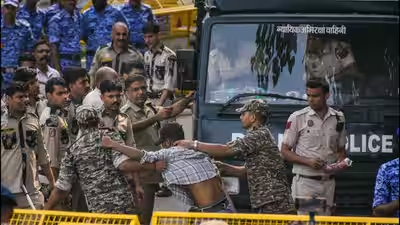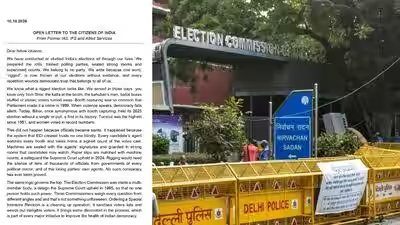










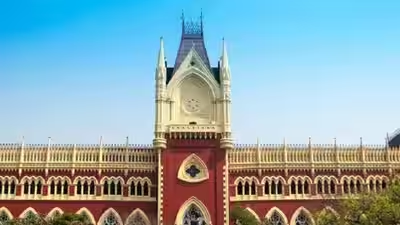

NEW DELHI: The Calcutta high court has ruled that peaceful protests cannot be treated as criminal offences simply because they are unwelcome to those in authority. The court stressed that the right to dissent and assemble peacefully is an integral part of democracy.The HC made these observations while quashing criminal proceedings against six School Service Commission (SSC) job aspirants who protested against alleged recruitment irregularities in August 2021.The ruling also comes amid a crackdown on protests in Delhi. Police have imposed security restrictions ahead of a planned mobilisation against the Special Intensive Revision (SIR) of electoral rolls. Opposition parties and left organisations have criticised the curbs. They have argued that such restrictions undermine the fundamental right to assemble and protest.Justice Anuj Singh said the police complaint failed to establish the essential ingredients of the offences charged against the protesters. These included unlawful assembly, wrongful restraint and acts likely to spread infection during the Covid-19 pandemic.“It is an unavoidable inference that the Petitioners are being punished for the protest, making it a vexatious and frivolous proceeding,” the court said.
Peaceful assembly not inherently illegal
The high ourt said merely gathering and raising slogans did not amount to an unlawful assembly. Under Section 141 of the Indian Penal Code (IPC), a gathering of five or more people is unlawful only if its common object falls within specific categories defined by law.“Thus, mere protest and raising slogans cannot be said to be an unlawful common object under Section 141,” the court said.The judge cited an earlier Calcutta high court ruling in Association for Protection of Democratic Rights v State of West Bengal. It held that a large gathering of demonstrators was not inherently illegal or unconstitutional.“Article 19(1)(b) of the Constitution of India confers upon all citizens of India the right to assemble peaceably. Therefore, any large assembly of demonstrators would not per se be either illegal or unconstitutional,” the court quoted from the earlier judgment.The court also referred to the Supreme Court’s decision in Javed Ahmad Hajam v State of Maharashtra. It said the right to dissent, criticise the government and protest peacefully within the law was integral to democracy.“Thus, a demonstration does not become an offence merely because it was unwelcome to those in authority,” the court held.
Police allegations failed to establish offences
The case arose from a protest on August 5, 2021. SSC job aspirants had gathered near Mayukh Bhawan in Salt Lake and were proceeding towards Bikash Bhawan. They were raising slogans against alleged recruitment irregularities.According to the police complaint, the gathering violated Covid-19 protocols and a prohibitory order under Section 144 of the Code of Criminal Procedure (CrPC). The complaint also alleged that the protesters refused to disperse, obstructed public movement and prevented officials from performing their duties.Thirteen people, including the six petitioners, were arrested.The petitioners argued that they were exercising their fundamental rights to freedom of speech and expression, and peaceful assembly. These rights are guaranteed under Articles 19(1)(a) and 19(1)(b) of the Constitution. They also said the criminal proceedings could harm their future employment prospects.The court found that the FIR did not establish the common object behind the gathering. It also failed to show how the protesters had committed the alleged offences.On the charge of disobeying a public servant’s order under Section 188 IPC, the court noted that the Section 144 CrPC order had not been placed on record. The complaint also failed to explain how the protest obstructed public movement or stopped officials from performing their duties.The charge of wrongful restraint under Section 341 IPC also lacked specific details. The FIR did not identify anyone who had been prevented from moving in a direction they were legally entitled to take.The court also rejected the allegations under Sections 269 and 270 IPC. These provisions deal with negligent or deliberate acts likely to spread infection. The FIR did not identify any specific act by the petitioners that could have spread Covid-19. Nor did it allege that they were infected or had reason to believe they were carrying the disease.The court said a general allegation of violating Covid-19 protocols was not enough to invoke Section 51 of the Disaster Management Act, 2005. The complaint did not specify which protocol had been breached. It also failed to explain how the petitioners had obstructed an official acting under the Act.
Share your thoughts in the comments
Be respectful · TOI community guidelines
FIR and proceedings quashed
The HC relied on the Supreme Court’s ruling in State of Haryana v Bhajan Lal. The ruling lays down that criminal proceedings can be quashed if the allegations, even when accepted in full, do not disclose an offence. The same applies when proceedings are manifestly attended by mala fides.The court concluded that the FIR did not establish a prima facie case against the six petitioners. It quashed the FIR registered at Bidhannagar North police station and all consequential proceedings.These included G.R. Case No. 901 of 2021, pending before the Additional Chief Judicial Magistrate, Bidhannagar.