












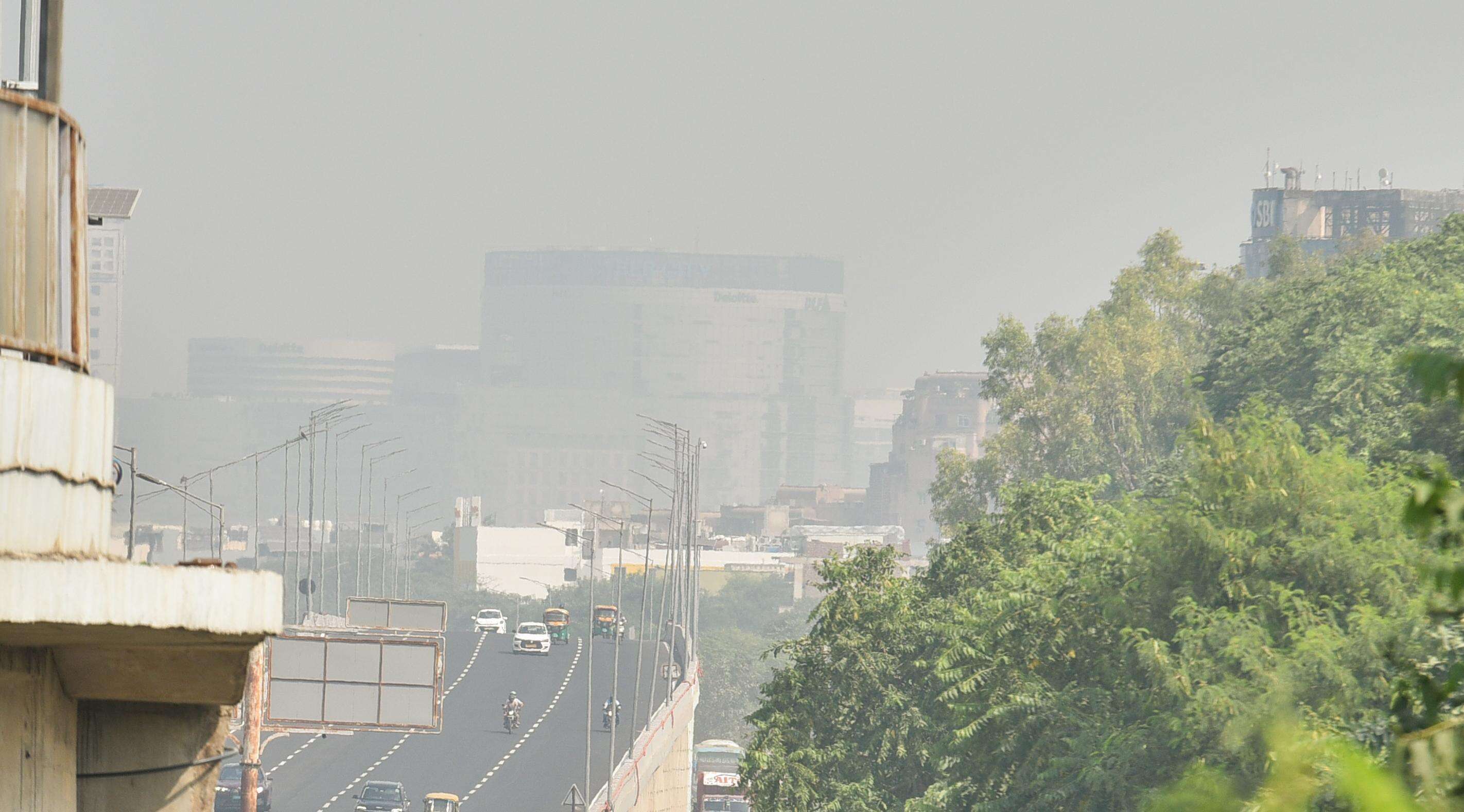
Gurgaon: The city’s air quality deteriorated on Friday, with the overall air quality index (AQI) rising to 215, placing it in the ‘poor’ category, according to Central Pollution Control Board (CPCB) data. The AQI was 193 on Thursday, 216 on Wednesday and 184 on Tuesday.Of the four monitoring stations in the city, only three were operational. NISE Gwal Pahari recorded the highest AQI at 242, followed by TERI Gram at 221. Sector 51 reported a comparatively lower reading of 153.Gwal Pahari also recorded the highest PM2.5 concentration at 240 micrograms per cubic metre (µg/m³), followed by TERI Gram at 238 µg/m³ and Sector 51 at 214 µg/m³. PM2.5 consists of fine particles that can penetrate deep into the lungs and enter the bloodstream.For PM10, Gwal Pahari recorded 235 µg/m³, followed by TERI Gram at 223 µg/m³ and Sector 51 at 213 µg/m³. The readings were substantially higher than the CPCB’s annual average standards of 40 µg/m³ for PM2.5 and 60 µg/m³ for PM10.The air quality early warning system for Delhi has forecast ‘poor’ air quality from Friday to Sunday, with unfavourable weather conditions likely to hinder the dispersion of pollutants across the region.“Science points to a clear pattern. Delhi’s daily average AQI reached 245 on Oct 21, the highest in 100 days, and the official early warning system expects ‘poor’ air to persist through Oct 25, with no change in the six days that follow. This is because cooler nights and slow winds are trapping pollutants,” said Prarthana Bohra, fellow at the Council on Energy, Environment and Water (CEEW).She said the system had flagged a ventilation index below 6,000 m²/s and wind speeds below 10 kmph as unfavourable for pollutant dispersion. Gurgaon’s monitoring stations, including Manesar, which recorded an AQI of 271 on Oct 22, reflected the same trend as the city is part of the same airshed, she added.Bohra said measures must focus on curbing emissions at the source, including cleaner and electrified transport, dust control and preventing open waste burning. She added that preventive action taken before pollution levels peak is more effective than emergency restrictions imposed later.According to CPCB guidelines, prolonged exposure to ‘poor’ air quality can cause breathing discomfort in people, while ‘moderate’ air quality can trigger respiratory problems in people with asthma and heart or lung conditions.An AQI of 0-50 is classified as ‘good’, 51-100 as ‘satisfactory’, 101-200 as ‘moderate’, 201-300 as ‘poor’, 301-400 as ‘very poor’ and 401-500 as ‘severe’.Experts said civic bodies needed to implement pollution-control measures throughout the year to keep air quality within the ‘satisfactory’ or ‘good’ categories.Haryana State Pollution Control Board (HSPCB) officials attributed much of the deterioration to local sources, including road dust kicked up by vehicular movement, increased construction activity and waste burning, which add to the pollutant load.