









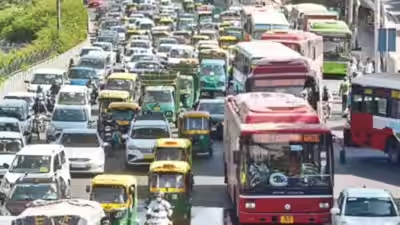
BAHADURGARH/SONIPAT: Delhi’s efforts to curb air pollution are set to intensify from November 1, with vehicles registered outside the national capital that fall below BS-VI emission standards barred from entering the city. The restriction is scheduled to remain in force until January 30, 2027, and will cover goods vehicles and buses as well. Electric vehicles (EVs), CNG- and LNG-powered vehicles, and specified vehicles engaged in emergency services and government duties will be exempt.The move is expected to affect commuters, transporters and businesses operating across the Delhi-NCR region. In Haryana, the districts of Gurugram, Faridabad, Jhajjar and Sonipat are stepping up awareness efforts, with transport officials urging vehicle owners and operators to familiarise themselves with the revised entry requirements before travelling to the capital.Jhajjar District Transport Officer (DTO) Ravish Hooda said the Haryana transport department was reaching out to vehicle owners, bus operators and transport unions to ensure that drivers were informed about the new requirements.He urged motorists to check their vehicles’ emission standards before entering Delhi and cautioned that vehicles registered outside the capital that fall below BS-VI standards should not enter the city while the restriction remains in force. Violations will invite action in accordance with the applicable rules, he said.Hooda added that vehicular emissions were a major contributor to air pollution and stressed the need to comply with prescribed emission standards. He also appealed to transport operators to ensure that all their drivers were informed about the new requirements in advance.In Sonipat, industrialist Dheeraj said most transporters had upgraded their vehicles to CNG-powered or BS-VI-compliant models over the past year, leaving the commercial transport sector relatively better prepared for the restrictions.However, he said owners of older luxury private vehicles could face greater difficulties. Vehicles regularly travel between Delhi and industrial hubs such as Rai and Kundli, making the restrictions a concern for businesses and individuals whose vehicles fall under the prohibited category.Dheeraj urged the government to consider the actual emission performance of vehicles in good condition, arguing that policy should take into account whether a vehicle meets the prescribed pollution standards.The Sonipat depot of Haryana Roadways has said its bus operations are unlikely to face major disruption under the new restrictions.Sanjay Kumar, general manager of the depot, said it operates 211 buses that comply with BS-VI emission standards. He added that the rules governing buses entering Delhi were already in place and that all buses at the Sonipat depot met the relevant emission requirements.As a result, the depot does not anticipate any major operational difficulties after the new restrictions take effect, he said.Under the announced provisions, electric vehicles and those running on compressed natural gas (CNG) or liquefied natural gas (LNG) will be exempt from the restriction. Specified vehicles engaged in emergency services and government duties will also be allowed to enter Delhi.The exemptions are expected to provide some relief to transport operators and other vehicle users. However, owners of vehicles that may fall under the restriction will need to verify the applicable requirements before travelling to the capital.Delhi’s restrictions come amid continuing efforts to reduce vehicular emissions across the National Capital Region, where daily commuting, industrial activity and freight movement connect the capital with neighbouring Haryana districts.The implementation of the rules will be closely watched by transporters, commuters and businesses that depend on regular movement between Delhi and industrial centres such as Rai and Kundli.Clear communication of the requirements and consistent enforcement will be crucial to minimising confusion among motorists while advancing the objective of improving air quality. The impact on traffic movement and freight operations is likely to become clearer once the restrictions take effect.