










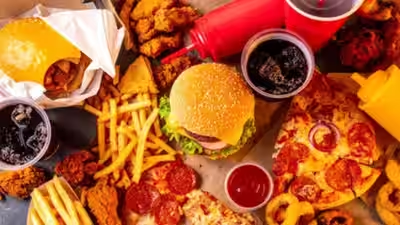
NEW DELHI: A packet of chips after school, a cookie between meals or a burger as a treat may seem harmless. But a new study suggests that eating more ultra-processed foods may be linked to changes in how children’s brains respond to food, as well as greater gains in body fat over the following year.Published in JAMA Network Open this month, the study followed 46 children who were at a healthy weight at the start. Researchers found that children who got a larger share of their daily calories from ultra-processed foods (UPFs) showed stronger responses in a brain region linked to reward, motivation and habit formation when they saw pictures of tempting foods such as cookies and French fries.These stronger brain responses were linked to greater increases in body mass index (BMI) and body fat over the next year. Children who ate more UPFs also showed an increase in waist size.The findings raise a new concern in the debate over childhood obesity: could the way children’s brains respond to food be part of the link between eating highly processed foods and gaining weight?Dr Arun Gupta, convenor of Nutrition Advocacy in Public Interest (NAPi) and co-author of the 2025 Lancet series on ultra-processed foods, said the findings should prompt a closer look at the foods children eat and how these products are marketed to them. He said repeated exposure to highly appealing foods could encourage habitual eating.The study, however, did not prove that children become addicted to food or that junk food directly changes their brains.The researchers also found that sugar alone may not explain the link. Many ultra-processed foods combine fat and carbohydrates, which can trigger a strong reward response in the brain. However, when researchers accounted for added-sugar intake, the link between UPF consumption and brain response weakened, suggesting that several factors may be involved.The findings come amid calls for tighter restrictions on advertising foods high in fat, sugar and salt (HFSS) to children. NAPi has sought amendments to the Press Council of India’s Norms of Journalistic Conduct 2022 to prohibit such advertising. The Press Council referred the proposal to the Union health ministry in May 2024, sought comments in June 2025 and sent a reminder in 2026, but NAPi says it is still awaiting a response.
Share your thoughts in the comments
Be respectful · TOI community guidelines
It has also written to the information and broadcasting ministry.Although the study was conducted in the US and its findings cannot be directly extrapolated to Indian children, it raises a key question: should tackling childhood obesity also mean addressing the advertising and food environments that shape children’s choices?