








In the ancient city of Varanasi, where death is believed to open the door to liberation, a 117-year-old mansion offers the dying a final home, where prayers and presence of loved ones accompany those who come here seeking moksha, reports Shailvee ShardaNot far from Ghanta Ghar Chauraha – the heart of Varanasi – lies the Misir Pokhara along the Nayee Sarak that houses Kashi Labh Mukti Bhawan. Behind the antique iron gate of this 117-year-old vintage Bengali mansion with a small garden lies the opportunity that allows the dying to transmigrate into the realm of the gods.But unlike the two Mumukshu Bhawans in the city, Kashi Labh Bhawan is open to people who reach the point of no return. Another difference is that in Mumukshu Bhawans, families may come and meet the renunciator but cannot stay with them.However, at Kashi Labh Bhawan, the family must live with their dear ones on their deathbeds so that they feel as if they were in their own home. The mood inside the mansion is pious and spiritual.
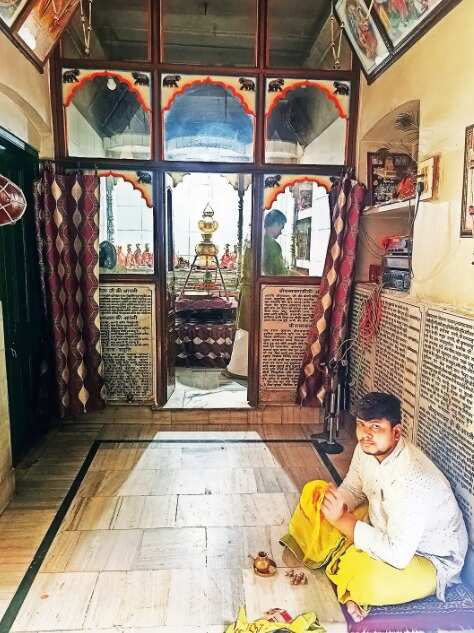
Varanasi, Kashi Labh Mukti Bhawan
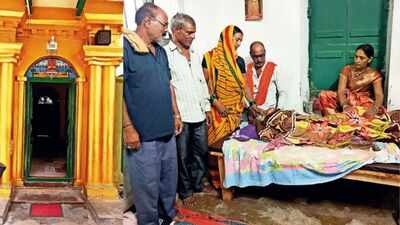
It is an abode full of idols while the outer walls are covered with colourful calendars carrying images of gods and goddesses.An ‘akhand jyot’ keeps burning to remind people that every ‘aatma’ (soul) emanates from ‘paramatma’ (supreme soul) and that the highest spiritual goal is to merge back into him. The solemn ‘Ram-naam’ chant in the background adds to the piety of the place.The door opens into a courtyard filled with daylight which brings the wandering mind back into the current state of the mortal world.On both sides are rooms – 10 in all – where terminally ill people stay. The truly minimalistic accommodation has old-fashioned, rectangular 14×16-foot rooms.Two wooden ‘chowki’ beds – one for the departing and the other for their caregiver – are laid on each side while the centre is kept vacant for easy movement. Though it is well ventilated and cooler than outside (because of the old thick brick walls), two fans are also provided.Families can also borrow utensils to cook their meals or bring ready-made food from the market. They are also advised to read out the Bhagavad Gita to their dear ones. If one is too overwhelmed, the temple priest on duty shares the responsibility.Three times a day, ‘kirtan karmacharyas’ (priests) pour a few drops of sacred ‘tulsidal’ and ‘Gangajal’ into the mouth of the dying person. The rituals continue till the soul departs from the bodily frame.After demise, the family members take away the body, leaving behind gloom and intriguing silence.Ceremonies are performed at Manikarnika Ghat that lies about a kilometre away. Here, it is assumed that Shiva would whisper ‘tarak mantra’ in the ear of the deceased and ensure that the person attains ‘moksha’.
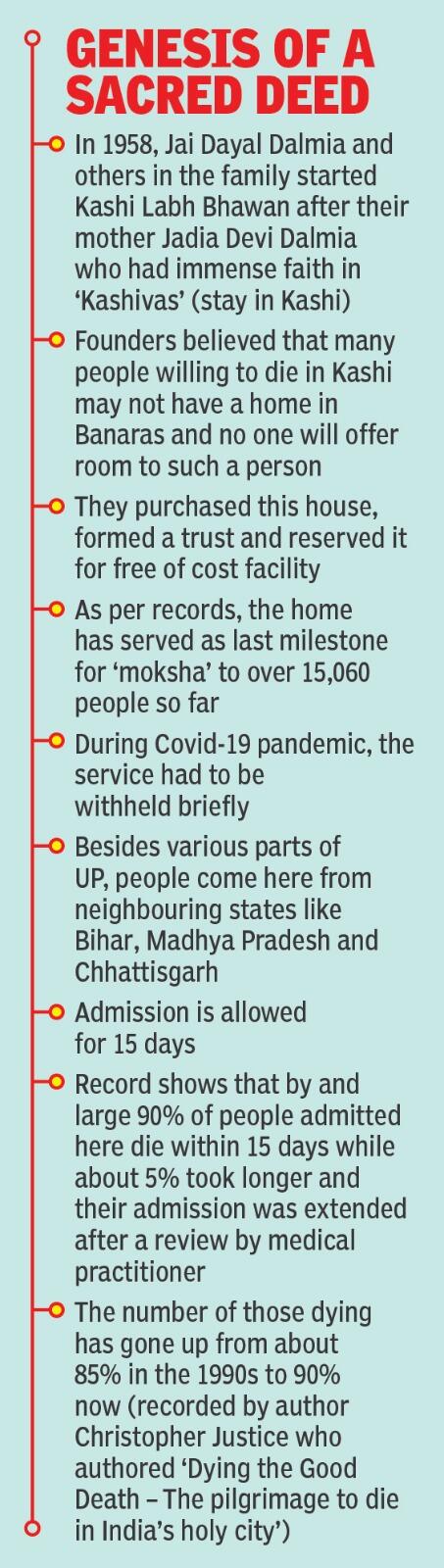
Kashi Labh Bhawan’s sacred journey
Urmila’s epilogue
Till the age of 75, Urmila Devi Kashyap, a resident of Debrai village in Kabirdham district of Chhattisgarh, was healthy and agile and would spend her day serving others.She would wake up in the wee hours to serve her god, visit a stable to feed cows before heading to the kitchen to cook for her grandchildren.The days were filled with warmth, love and laughter. On a cold winter morning four years ago, the affectionate grandma was found unconscious in the stable.“We took her to the hospital where the doctors discovered that Amma had suffered a brain stroke which left the right side of her body paralysed. She survived but normalcy was totally lost,” recalls her son Chinta Ram.She remained bedridden under the care of her daughter-in-law, daughters and grandchildren. She could barely speak but her family could read her expressions. Six months ago, her husband Sitaram Kashyap had died. The emotional setback added to her physical misery.“After some time, she stopped eating and drinking. Two days later, her breathing pattern changed. She started breathing from her mouth. Even the local ‘vaidyas’ told us that there was no medicine for death,” recalls her daughter-in-law Nisha.The family felt that the best they could do for her was to take her to Kashi and help her soul attain ‘moksha’.Upon reaching Kashi, the family settled in a room at Kashi Labh Bhawan. Urmila’s grandson, Rohit (28), came to know about Kashi Labh Bhawan through his father’s older cousin. “Someone in his village was also brought here,” recalls Rohit.Gloominess intensified by the night. The family members tried to rest, but sleep eluded them.The wait resumed the next morning amid the mundane drills of daily life. After lunch, someone realised that her breathing had become shallower. Around 4pm, she took in two drops of ‘Gangajal’.A few minutes later, someone said that she had moved towards ‘moksha’. The staff confirmed that she had died. Rohit says he initially doubted the family’s decision to bring her to Kashi Labh Bhawan but felt otherwise when he reached Varanasi.“This is the place which promised to offer some solace to my grandmother unlike the doctors who had given up on her,” he says. Asked about his understanding of ‘moksha’, he remarks: “Scriptures have it, and we believe in it. Faith brought us here. I can say whatever happened was for her good.”
Beholders of the final moment
‘A place full of love and light’, ‘Going with enlightenment’, ‘Leaving with a painful and heavy heart filled with truth’, and ‘Moving to see death treated with gentle reverence’… These are some of the comments made in the visitors’ book at Kashi Labh Bhawan. It speaks volumes about what ‘kirtan karmacharyas’ and other staff members go through as they witness death with such proximity.Even those looking from a distance describe the scenes as distressing, depressing or upsetting. “Many times people come with oxygen cylinders,” a shopkeeper says.Another shopkeeper says there are times when the relatives return in the same ambulance in which they brought their dear ones.“Those who come here in their final days are frail, pale and underweight. One can look at them and see life walking away with every breath,” says a former worker.More than anything else, these general comments speak for the kind of courage the workers at the Kashi Labh Bhawan show when they witness death.“At times, departure is calm but sometimes it is a prolonged struggle for every breath. It is common to see people hallucinating, as if they are talking to their departed dear ones. One also gets to see how regrets and fears haunt people in the final moments,” says caretaker Anurag Shukla, who has lived in the Kashi Labh Bhawan since his childhood.His father was also his predecessor in this role. But where does the strength to brave the pain and burden of other people come from?“I think it is the sense of purpose. We just try to make things easier for the departing,” says priest Shiva Dayal Chaubey who can look at a person and predict how many days or hours he or she will live.“There is no magic behind this. Laboured breath, twitching hands, cold feet, eyes staring into oblivion, mottled skin, uncontrolled motion are some signs described even in the Puranic literature that indicate an approaching death,” says Chaubey, who has seen some 1,000 deaths in the past decade.“I have seen people dying since my childhood as my father was the manager before me. Having seen death so closely has humbled me to the core. It has made me an ardent believer of the theory of ‘karma’ which guides and guards me in everyday life,” he says.