






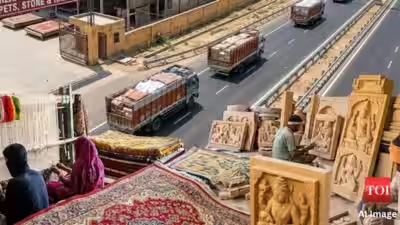
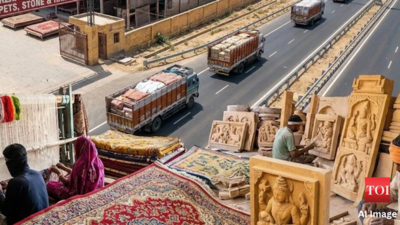
Mirzapur has long occupied a distinctive place in Uttar Pradesh’s traditional economy, known nationally and internationally for its carpets, stone products and a wide range of handicrafts. Yet, for decades, the district’s economic potential remained constrained by limited infrastructure, inadequate market linkages and connectivity gaps.Over the last nine years, the development approach under the Yogi Adityanath government has increasingly sought to address these constraints by strengthening roads, logistics, industrial infrastructure, tourism and market access. The result is an emerging economic ecosystem in which traditional skills are being linked with modern infrastructure and wider markets.The transformation is particularly significant because Mirzapur’s economy is closely intertwined with its artisan communities. Carpet weaving, stone processing, brass and metal crafts, wooden products and other traditional activities provide livelihoods to thousands of families. The government’s emphasis on the One District One Product (ODOP) approach has helped place these traditional products within a more structured framework of promotion, branding, finance, skill development and market access.
Carpet industry moves towards wider markets
Mirzapur’s carpet industry is one of its most recognised economic strengths. Along with neighbouring Bhadohi and Varanasi, the region forms an important carpet and textile production belt of eastern Uttar Pradesh. Mirzapur’s hand-knotted and handwoven carpets have traditionally found markets beyond the state and across the country, while export-oriented production has provided employment to artisans, weavers, traders and supporting businesses.The ODOP framework has provided greater visibility to such traditional products. Instead of treating handicrafts merely as cottage activities, the policy approach has increasingly focused on developing them as commercially viable enterprises. Assistance for skill enhancement, toolkits, finance, common facilities, packaging, branding and participation in exhibitions has helped artisans and small entrepreneurs improve their ability to compete in larger markets.Digital commerce has further expanded opportunities. Artisans and micro-enterprises are increasingly able to showcase products beyond their immediate geographical markets. Government procurement platforms and organised exhibitions also provide avenues for connecting producers with institutional buyers.This shift is important because the future of Mirzapur’s carpet economy depends not only on preserving traditional designs and weaving skills but also on improving productivity, quality, packaging and market access.
Stone industry gets infrastructure support
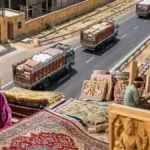
Stone is another major pillar of Mirzapur’s economic identity. The district is endowed with significant stone resources and has developed a substantial ecosystem around stone quarrying, cutting, processing and related activities. Chunar, in particular, has historically been associated with distinctive stone products and construction materials.The stone economy supports a chain of activities extending from extraction and processing to transportation, construction and trade. Better road connectivity therefore has a direct economic impact on the sector. Faster movement of raw materials and finished products reduces transportation constraints and improves access to markets in other parts of Uttar Pradesh and neighbouring states.At the same time, the broader industrial policy environment has encouraged enterprises to look beyond traditional extraction towards value addition. Processing stone into finished products, architectural elements, decorative items and handicrafts can generate significantly greater economic value than the sale of raw material alone.This emphasis on value addition is particularly relevant for employment generation. Small processing units, artisans, transporters and service providers can participate in the industrial chain, creating a broader economic impact than resource extraction by itself.
Connectivity becomes a force multiplier
One of the most visible changes affecting Mirzapur’s economic prospects has been the improvement in connectivity. The district’s location in the Vindhya region gives it strategic importance, but economic growth requires efficient links with major markets and urban centres.Improved road networks and better connectivity with Prayagraj, Varanasi, Sonbhadra and other parts of eastern Uttar Pradesh have reduced the sense of geographical isolation. The expansion of major road infrastructure across the region has also strengthened access to national markets.For artisans and small manufacturers, connectivity is not simply a transport issue. It determines the cost and speed at which products reach buyers. A carpet producer, stone processor or handicraft entrepreneur can benefit directly when finished goods can be transported more efficiently to warehouses, exhibitions, wholesalers and consumers.Improved connectivity also supports tourism. Mirzapur possesses substantial religious, cultural and natural tourism potential, including Vindhyachal, Chunar Fort, waterfalls and the Vindhya landscape. Rising tourist movement creates additional demand for handicrafts, local products, food, transport and hospitality services.
Handicrafts gain a larger economic role
The district’s handicraft economy represents another important avenue for inclusive growth. Traditional skills, often passed from one generation to another, can provide employment without requiring large industrial investments. However, artisans need access to credit, modern tools, design inputs and markets if traditional occupations are to remain economically sustainable.Government schemes supporting micro, small and traditional enterprises have sought to bridge this gap. The broader policy focus on entrepreneurship has encouraged artisans to view themselves not merely as wage earners but as potential business owners.Skill development and product diversification are also becoming increasingly important. Traditional craftsmanship can be adapted to contemporary consumer preferences through new designs, improved finishing and modern packaging while retaining the cultural identity of the product.Women can particularly benefit from such home-based and small-scale enterprises, allowing traditional skills to become a source of supplementary or primary household income.
Tourism and traditional economy reinforce each other
Mirzapur’s economic transformation is also linked to the development of tourism infrastructure. Vindhyachal is one of the major religious centres of Uttar Pradesh, while Chunar and the surrounding Vindhya landscape offer significant heritage and ecotourism possibilities.As connectivity improves and tourist facilities expand, the potential market for locally produced carpets, handicrafts, stone artefacts and souvenirs also increases. Tourism can therefore create a multiplier effect: visitors generate demand not only for hotels and transport but also for local crafts, food products and cultural experiences.This integration of tourism with local production can provide artisans with a direct consumer market while strengthening the district’s identity as a destination associated with traditional craftsmanship.
From traditional production to a modern economic ecosystem
The transformation underway in Mirzapur is ultimately about moving from isolated traditional activities towards a connected economic ecosystem. Carpet weaving, stone processing and handicrafts remain rooted in the district’s heritage, but improved infrastructure, government schemes, entrepreneurship promotion and market access are creating new possibilities around them.The larger challenge is to sustain this momentum by encouraging greater value addition, modern design, quality certification, branding and export-oriented production. Better access to affordable finance and technology can help small enterprises expand, while continued improvements in logistics can make Mirzapur more competitive.The district’s traditional industries have survived because of generations of craftsmanship. The emerging development model seeks to give that craftsmanship a modern economic foundation. With stronger connectivity bringing producers closer to markets, government support strengthening enterprises and tourism creating new demand, Mirzapur is increasingly positioned to turn its traditional strengths in carpets, stone and handicrafts into engines of broader and more sustainable economic growth.