










LUCKNOW: Muzaffarnagar has long occupied a pivotal position in Uttar Pradesh’s sugar economy. Located in the fertile western part of the state, the district has traditionally been identified with vast sugarcane fields, sugar mills and a strong network of farmers whose livelihoods are closely linked to the crop.Over the past nine years, however, the district’s economic profile has increasingly moved beyond conventional sugar production, with greater emphasis on agro-processing, value addition, rural infrastructure and investment.The transformation is significant because agriculture remains at the heart of Muzaffarnagar’s economy. The district’s fertile alluvial soil, irrigation facilities and favourable agro-climatic conditions have made it one of the important sugarcane-producing areas of western Uttar Pradesh.Sugarcane supports not only farmers but also an extensive rural ecosystem involving sugar mills, transporters, farm-equipment suppliers, labourers, traders and ancillary industries.The Yogi Adityanath government has sought to strengthen this established economic base while encouraging greater value addition. The broader policy approach has been to move agriculture from a primarily raw-produce economy towards processing, manufacturing and market-linked activity.In a district such as Muzaffarnagar, this approach has particular relevance because sugarcane provides the raw material for a wide range of industrial activities.
Strengthening the sugar economy
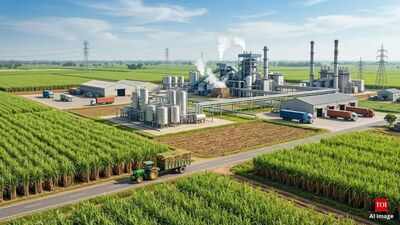
Sugar mills remain central to Muzaffarnagar’s industrial identity. The district and surrounding western Uttar Pradesh region have a dense concentration of sugar factories, creating an important farm-to-industry linkage.The regular procurement of sugarcane provides farmers with a major source of agricultural income while ensuring a dependable raw-material supply for the processing industry.During the past nine years, the state government has placed considerable emphasis on ensuring timely payment of sugarcane dues, improving mill operations and strengthening the overall sugarcane value chain. Measures aimed at improving digital systems, monitoring cane procurement and payments, and increasing transparency have helped bring greater institutional oversight to the sector.The importance of the sugar economy extends well beyond the production of sugar. Sugar mills generate employment directly and indirectly and create demand for transportation, machinery maintenance, packaging, engineering services and other supporting activities.This makes the sugar industry an important pillar of the district’s rural-industrial economy.
From sugar to value-added products
One of the most important changes in the agro-economic landscape is the growing emphasis on diversification. Sugarcane can generate considerably greater economic value when it is processed into multiple products rather than being used only for conventional sugar production.Ethanol has emerged as one of the most important examples. The expansion of ethanol production from sugarcane and molasses has provided sugar mills with an additional revenue stream while contributing to the country’s effort to reduce dependence on imported fossil fuels.For sugar-producing districts such as Muzaffarnagar, the development of the ethanol economy creates opportunities to make the sugar industry more resilient to fluctuations in sugar prices.Other by-products of sugar production, including molasses, bagasse and press mud, also have economic value. Bagasse can be used for cogeneration of electricity, while molasses provides a raw material for distilleries and ethanol production.Such diversification effectively turns the sugar mill into a broader bio-resource and agro-processing centre.This approach has the potential to strengthen the economics of the entire sugarcane chain. Instead of depending solely on the price of sugar, mills can generate revenue from several linked products, improving their capacity to sustain operations and make payments to farmers.
Agriculture meets industry
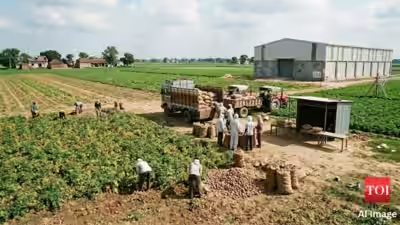
Muzaffarnagar’s agro-processing potential is not restricted to sugarcane. The district has a substantial agricultural base producing wheat, rice, vegetables, fruits, oilseeds and other crops.Better processing and packaging infrastructure can enable these products to move from local agricultural markets into higher-value domestic and national markets.Government programmes supporting food processing, micro and small enterprises, cold-chain infrastructure, warehousing and modern marketing have created opportunities for entrepreneurs to establish units closer to the source of raw materials.This is particularly important for rural employment. Agro-processing units can create non-farm employment in villages and small towns, allowing local populations to participate in the value chain without having to migrate to larger cities.Activities such as grading, sorting, packaging, storage, food processing, transportation and marketing can generate employment alongside farming.
MSMEs and the rural industrial base
The expansion of agro-processing is also closely connected with the growth of micro, small and medium enterprises. Muzaffarnagar has a long tradition of small-scale industrial activity, and the availability of agricultural raw material provides a natural foundation for food-processing and allied enterprises.Government initiatives promoting formalisation, easier credit, digital registration, skill development and market access have sought to bring more small enterprises into the organised economy.Schemes such as the PM Formalisation of Micro Food Processing Enterprises programme have also created opportunities for small food businesses to upgrade technology, improve packaging and build stronger market identities.For farmers, such developments can open alternative channels for selling produce. For entrepreneurs, they provide access to a large and readily available raw-material base.For the district economy, they mean greater value is retained locally instead of agricultural produce leaving the district in an unprocessed form.
Infrastructure supporting economic expansion
Improved roads, connectivity and logistics are another important component of Muzaffarnagar’s economic transformation. The district’s location between major economic centres of western Uttar Pradesh and the National Capital Region gives it a significant logistical advantage.Better connectivity can reduce transportation costs for agricultural produce and processed goods, while improved digital infrastructure enables businesses to access wider markets.The expansion of warehousing, cold storage and modern logistics can further strengthen the district’s position as an agro-processing centre.The combination of agricultural production, industrial capacity and connectivity gives Muzaffarnagar the potential to develop a more integrated rural-industrial economy.
A new phase of rural prosperity
The transformation of Muzaffarnagar is therefore not simply a story of sugar mills. It represents an effort to build a broader economic ecosystem around agriculture.Sugarcane remains the backbone, but ethanol, energy generation, food processing, MSMEs, logistics and value-added agricultural products are increasingly becoming complementary components.The larger policy objective under the Yogi government has been to strengthen the link between farmers and industry, improve the investment environment and create opportunities for value addition within Uttar Pradesh.In Muzaffarnagar, this approach is particularly visible because of the district’s strong agricultural foundation and established industrial network.The next phase of growth will depend on deeper diversification, modern processing technology, stronger farmer-producer linkages, efficient storage and cold-chain infrastructure, and greater access to national and export markets.If these elements continue to develop together, Muzaffarnagar can increasingly move from being known primarily as a sugarcane and sugar-producing district to becoming a diversified agro-industrial hub.Its transformation thus reflects a broader shift taking place across western Uttar Pradesh: agriculture is no longer being viewed only as a source of raw material, but as the starting point of a larger value chain involving processing, manufacturing, energy, logistics and entrepreneurship.For Muzaffarnagar, that transition offers the prospect of converting its traditional strength in sugarcane into a more diversified and sustainable engine of rural and industrial growth.