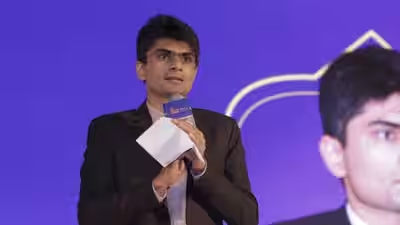










Uttar Pradesh aims to emerge as a global manufacturing and manpower supply hub by 2030, with government schemes, improved infrastructure and artificial intelligence opening up new opportunities for employment and entrepreneurship, industry leaders and a senior state official said at the TOI Youth Icons Summit & Awards 2026 in Lucknow on Tuesday.The panel discussion, titled ‘Degree to Destiny: Jobs, Skills and Startups in the New UP’, brought together Shashi Bhushan Lal, principal secretary, msme and export promotion department, government of Uttar Pradesh; Rama Krishna, EndureAir Systems; Mayank, CEO and founder of global technology consulting firm ADROSONIC; and Ankit Sahani, founder of The Hazelnut Factory. The discussion was moderated by Meghna Deka, National Editor and Head of Video Strategy.Speaking about his decision to join the civil services, Shashi Bhushan Lal said the opportunity to serve society and the nation was a major motivation.“Serving the nation, society is the big incentive,” he said, adding that faster career progression, diverse opportunities to serve people and job satisfaction had attracted him to the civil services.On the state’s export growth, Lal credited the One District One Product (ODOP) scheme with bringing local products into the spotlight and helping them reach wider markets. The initiative identified products associated with individual districts and gave them visibility through showrooms, fairs and exhibitions in India and abroad, accordig to him.The state’s Export Promotion Bureau also helped exporters access international markets, he said, adding that Uttar Pradesh is increasingly being recognised as an export destination. Lal said the benefits of this expansion were also reaching artisans and traditional craftspeople, or kaarigars. Alongside greater market access, various insurance and health schemes were providing direct support to artisans, while their incomes had risen substantially, in some cases by two to three times, he said.Acknowledging the challenges faced by a landlocked state, Lal added that capacity-building initiatives would help manufacturers and exporters improve their competitiveness and take advantage of free trade agreements (FTAs), he added.On uncertainty surrounding the India-US trade agreement, Lal said Uttar Pradesh had performed well even amid difficult tariff barriers and would seek to maximise the benefits of trade agreements as they emerged.Then, Rama Krishna, representing EndureAir Systems, which manufactures unmanned aerial vehicles (UAVs) and drones, highlighted the role of institutions such as the Indian Institutes of Technology (IITs), government schemes and incubators in supporting startups, particularly in deep technology and defence. “When you’re building a startup in deeptech or defence space you need support,” he said, stressing the importance of incubation and the required support especially during the initial three to four years of a venture.He called for greater access to testing facilities and land, which can be expensive for early-stage companies, along with stronger links to end users and skilled manpower. Training facilities, educational institutions and engineering colleges could play a greater role in supporting emerging businesses, he said. Then, asked to identify a skill graduates would need by 2030, Rama Krishna pointed to an understanding of hardware systems engineering.Meanwhile, Mayank spoke on artificial intelligence apsect urging that it should be viewed not merely as a source of employment but also as a tool for solving problems and creating new businesses. “There is a lot of opportunities that AI is going to bring. We just need to change the perspective a bit. We should not just look at it as a job opportunity,” he said.He argued that entrepreneurs who identified problems around them and explored how AI could help solve them would be better placed to create new ventures, which could subsequently generate jobs.On inclusive AI and governance, Mayank emphasised the need to establish appropriate guardrails and ethical standards to ensure that the technology was developed and deployed responsibly.Contunuing th panel, Ankit Sahani, founder of The Hazelnut Factory, said Uttar Pradesh’s large consumer base, improving infrastructure, better connectivity and changes in the law-and-order situation had strengthened its appeal for businesses.“UP is the biggest consumer market today,” he said, describing the state’s transformation as significant. Having grown up in Uttar Pradesh, Sahani said he had recognised its potential and was grateful to the people of the state for supporting the growth of his business.He predicted that the state’s startup ecosystem would undergo a major transformation over the next five years.Addressing the perception that setting up a business in Uttar Pradesh involved greater difficulties, Sahani said the challenges of entrepreneurship were not unique to the state. “The struggle is everywhere, not just UP,” he said.The session was part of the TOI Youth Icons Summit & Awards 2026, UP Chapter, being held in Lucknow on October 27 to celebrate young achievers and changemakers across enterprise, sports, society, culture and social media. The summit also features discussions on Uttar Pradesh’s transformation, including employment opportunities, safety, connectivity and the changing aspirations of its youth.