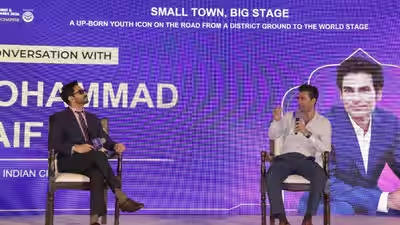








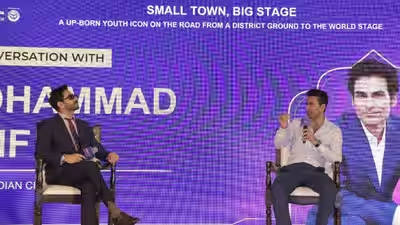

Former India cricketer Mohammad Kaif spoke candidly about the challenges of rising to the national stage from Uttar Pradesh in a conversation with actor and host Aparshakti Khurana in Lucknow. The discussion, aimed at encouraging young people, covered Mr. Kaif’s early struggles, the state’s cricketing record, the role of facilities and sponsorship, and the habits that built his fitness.Mr. Khurana opened by recalling their earlier meetings in the Star Sports studio, saying that sharing a stage in Lucknow felt like coming “to your house.” He then posed the central question: how difficult is it to reach the big stage, and what was the most difficult thing in the early days for a cricketer from Uttar Pradesh?
Early beginnings: A hostel at twelve
Mr. Kaif said his journey began early. “I left home at the age of 12,” he said. “I went to a hostel. I trained there.” He stressed that hardship is not unique to him, saying “Everyone’s journey is difficult. It is not easy to reach up to the top.”He noted, however, that the path is steeper for players from his home state. “Especially in UP, compared to other states, it is a little more difficult,” he said, comparing the facilities available with those in Maharashtra or Karnataka. He also recalled facing scepticism about where talent comes from. “People ask me, how did you play in India? In Uttar Pradesh, there are not many players,” he said, adding that when his team played in Mumbai, people would ask where a cricketer from Uttar Pradesh plays.His response was to turn disadvantage into drive. “People from small cities are more hungry. There is no doubt about that,” he said. He compared his own start with the comfort of today’s children, noting that his son, who lives in Gurgaon, travels to school and back in an air-conditioned car. “We started from a poor family. We did not have much. So, we had to do everything on our own.” Players from small cities, he said, have “less margin for mistakes,” and he learned early that “you have to earn.” His conclusion was plain: “I did a lot of hard work. I got the result later.”
Talent that was not rewarded
Mr. Khurana asked a two-part question, the second of which he acknowledged was difficult: whether talented Uttar Pradesh cricketers of Mr. Kaif’s generation failed to reach the national side because things did not “pan out at the right time,” and whether any player had played who perhaps should not have. He told Mr. Kaif he was free to decline the latter part.Mr. Kaif named Ashish Zaidi as a prolific player who, he believed, would have performed had he been given a chance for the country. He then explained why players such as Suresh Raina, RP Singh, Piyush Chawla and Bhuvneshwar Kumar did reach the Indian team: “In Uttar Pradesh, there was a change in winning mindset.”When he captained the state, he said, Uttar Pradesh won the Ranji Trophy. “When a Ranji player wins a trophy, the team automatically selects him. You come from a winning mindset. You play to win and you make the team win.” He cited Mr. Raina, who scored 90 in the Ranji final, and said several teammates who excelled that season went on to play for India. Before that, he said, “we were talented but we couldn’t defeat a big team.”He pointed to 2006, when he led Uttar Pradesh to Mumbai. “If you defeat Mumbai in Mumbai, it will be a blast,” he said. Winning in a rival’s home, he added, forces people to ask how it happened. Heroes, he said, inspire the next generation. “We got inspired by Sachin paji (Tendulkar), Kapil Dev, Azharuddin. You get inspired when you see a hero. We were heroes of UP.” He noted that Chief Minister Yogi Adityanath had honoured medal winners with awards.On the question of who deserved selection, Mr. Kaif was measured, saying that “playing for India is a matter of pride” and that only a few of the millions who play get the chance, many being rewarded “after 15-20 years of hard work.” He declined to name anyone.
Facilities, sponsors and the guru
Mr. Khurana observed that Indian cricket has changed dramatically, with brands, supporting staff and facilities now commonplace, and asked whether this helps players or makes them complacent. He also asked whether the coach, once regarded as a guru, has lost that stature.Mr. Kaif recalled that the 2006 title brought a turning point for cricket in Uttar Pradesh. A sponsor came on board after the victory; before that, he said, “we didn’t even have our own t-shirt.” He argued that the sequence was backwards. “You should invest in your players from the start. You should get them on the ground, and then you’ll get the reward.” He pointed to other countries that prepare athletes for the gold medal from childhood, saying, “It’s a culture from childhood. Which I want to see in India and UP.”
Swimming, cycling and endurance
Asked about the era when players swept floors, laid mats and rolled pitches themselves, Mr. Kaif described the routines that built his fitness. At 10 or 11 years old, living 3 to 4 kilometres from the Sangam in Prayagraj, he would swim there for one to two hours and then cycle home. He also cycled to the Madan Mohan Malviya Stadium in the early hours of the morning. “My body was tired, but my mind pushed me,” he said. The extra effort, he explained, helped him build endurance and fitness, and he became “the fittest player amongst all of them.“Concluding, Mr. Kaif distilled his outlook into a single line: “In life, every day is a battle. I grew up fighting.” When the world says you cannot do it, he said, players from Allahabad treat the challenge as “a question of fighting spirit.”