



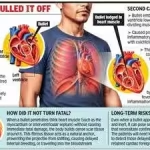


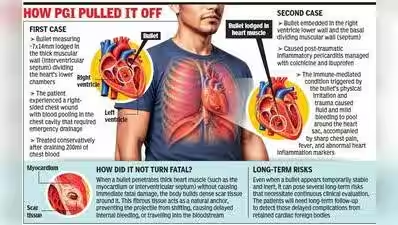
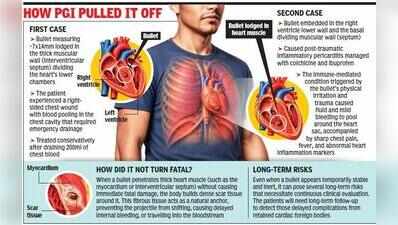
Chandigarh: Most of us would assume a bullet trapped inside a beating heart is an instant death sentence. Yet we have two live, walking examples.When two gunshot victims arrived at the Post Graduate Institute of Medical Education and Research (PGIMER) with live rounds embedded deep within their cardiac walls, the medical team didn’t reach for a scalpel — they simply let the heart keep beating.How they skipped a high-risk open-heart surgery and lived to tell the tale was published in the international journal Catheterization and Cardiovascular Interventions.The first case involved an adult man who arrived at the emergency room with a right-sided chest gunshot wound, breathing difficulty, and blood pooling in his chest cavity. Emergency staff drained approximately 200ml of blood to ease his breathing, and subsequent scans revealed a metallic bullet measuring about 7-by-14mm stuck inside the thick muscular wall dividing the heart’s lower chambers.Because the patient’s heart rhythm was normal and the bullet was stable, the trauma team chose a non-surgical approach. Bullet wounds to the chest are usually treated as terrifying medical emergencies that demand immediate open-heart surgery.However, because this patient’s heart was beating steadily, his electrical signals were normal, and the bullet was completely stable, the hospital’s trauma team made the bold choice to leave the bullet right where it was. “Operating to pull it out could have caused far more damage to delicate heart tissues than leaving it alone,” said Dr Rajesh Vijayvergia, cardiologist and lead physician. The patient recovered and remained symptom-free during two years of follow-up checks.The second case featured a 33-year-old bystander who returned five days after a shooting with chest pain and a low-grade fever. Scans revealed a bullet embedded directly in the lower wall of the right ventricle and the basal dividing muscular wall.The irritation triggered post-traumatic inflammatory pericarditis, causing fluid to pool around the heart sac. Instead of high-risk surgery, doctors successfully treated him with targeted medications including colchicine and ibuprofen. He has remained fine during a one-year follow-up.Doctors cautioned that this conservative approach is not suitable for all gunshot victims, particularly those experiencing active bleeding, cardiac instability, or serious structural damage.