










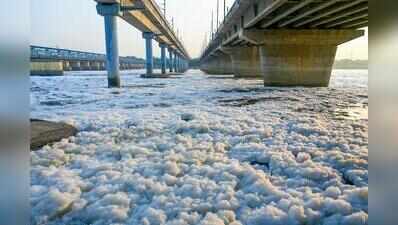
Noida: Supreme Court on Wednesday said a Yamuna clean-up plan, drawn up by a high-powered committee headed by the Union home secretary, leaves the definition of its floodplain unsettled and offers no rehabilitation scheme for those living on it.A bench comprising Justices Manoj Mishra and Manmohan raised the concerns during a presentation by the court-appointed committee to draw up a comprehensive action plan for the river.The judges asked why the definition of active floodplains used in River Ganga (Rejuvenation, Protection and Management) Authorities Order, 2016, was different from Delhi Master Plan 2041 and said such categorisation could open the door to fresh litigation. They also asked why the plan contained no relocation and rehabilitation scheme for unauthorised structures built in critical zones along the river.The bench raised the matter of 1,799 unauthorised colonies and asked whether they sat on fragile floodplain zones. It also expressed doubt that the large gap in sewage treatment could be bridged enough to improve the river’s health, while accepting that sewage was a major factor in the pollution.In the 2016 order, a floodplain is defined as an area of Ganga or its tributaries that comes under water on either side of it due to floods corresponding to its greatest flow or with a flood of frequency once in 100 years. The draft Delhi Master Plan 2041 refers to the area along the river that comes under floodwaters once every five years as the ‘active floodplain’, and demarcates a ‘floodplain’ as the area which corresponds to its greatest flow or a flood of frequency of one-in-100 years.According to petitioner Abhisht Kusum Gupta, who attended the presentation, the bench was critical of contradictions within the report. One section stated that all encroachments on water bodies had been removed, while another admitted that the riverbank was encroached upon. “The bench was critical of a part of the report and pointed out that in one section the officials have stated that all encroachments on water bodies have been removed and in another section they have admitted that the riverbank is encroached upon,” Gupta said.The judges directed officials to remove all such contradictions so the court could consider uploading the report in the public domain to invite suggestions.The report tabled by the committee in Sept found that domestic sewage was the primary driver of Yamuna pollution. It stated that an estimated 7,999 million litres per day (MLD) of sewage is generated in the catchment across the five states — Uttarakhand, Himachal Pradesh, Haryana, Delhi and UP — along its course. Of this, 6,243.8 MLD is treated, leaving a gap of 1,756 MLD (21.9%). UP, the report stated, is the largest contributor of untreated waste, with a sewage treatment gap of 34%.The committee outlined a three-pronged strategy to stop pollution entering rivers and drains, increase environmental flow in Yamuna, and manage the floodplain and restore water bodies. Officials said capacity at some operational sewage treatment plants should be augmented and at least 125 new plants installed.The 79-slide presentation was based on a 450-page Yamuna Action Plan prepared under amicus curiae K Parameshwar and submitted on Sept 22. It was delivered by officials from Department of Home, Delhi Jal Board and Delhi Development Authority.Parameshwar told TOI that the plan was the product of immense work involving the chief secretaries of the five basin states and other stakeholders. “It was a closed-door presentation in which the judges gave their good feedback,” he said.The matter is linked to appeals filed by Noida Authority and Delhi Jal Board against a National Green Tribunal order imposing environmental compensation of Rs 150 crore on them. It will be heard next on Nov 4.