








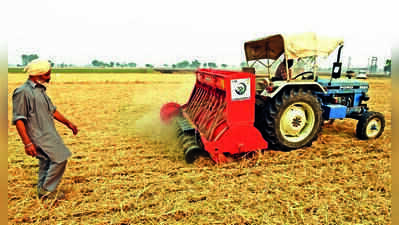
Gurgaon: A new study has highlighted the gap between the adoption of alternatives to stubble burning and the financial incentives available to farmers. Only 7% of farmers who bale straw have reported that they receive payments from buyers. Four in five Haryana farmers, who bale paddy straw or use it as fodder, are planning to continue these practices in 2026. The catch: the lack of a viable market for the residue remains a major hurdle, according to the study.“Farmers’ willingness to continue alternatives to burning was encouraging, but financial returns would determine whether these practices could be sustained,” said Kurinji Kemanth, programme lead and co-author of the study — conducted by Council on Energy, Environment and Water (CEEW) — based on a survey of 1,588 farmers across 144 villages in 12 districts across the state. “When straw earns farmers money, zero-burn farming begins to sustain itself,” Kemanth said.According to the study, while 39% of respondents use paddy residue as fodder, 38% bale it and 32% incorporate it into the soil using machinery. The practices overlap, with farmers often using more than one method. Among farmers who bale straw, 87% rely on aggregators to collect it. However, 62% give the straw away, while 31% pay around Rs 1,000 per acre to get their fields cleared. The findings indicate that removing straw from fields does not necessarily translate into an income for farmers.The state’s incentive programme has also not reached all farmers who applied. Around 80% of surveyed farmers were aware of Haryana’s Parali Protsahan Yojana, which offers Rs 1,200 per acre to farmers who do not burn crop residue. However, only 42% applied for the scheme and 57% of applicants received payments, the study found.The findings come as north India enters the peak period for stubble burning. The survey, conducted between Jan and March 2026, covered districts that accounted for around 92% of Haryana’s kharif fire events between 2018 and 2024. Baling uses a machine called a baler to collect loose straw from the ground and bind it firmly into rectangular or circular shapes using twine, string or wire.Haryana recorded 1,945 stubble-burning incidents between Sept 15 and Oct 27 in 2020, rising to 2,103 in 2021 before declining to 1,578 in 2022, 1,005 in 2023 and 713 in 2024. The count dropped sharply to 78 in 2025 and further to 22 this year, according to data. The city reported zero incidents in each of these seven years. In 2026, Palwal recorded the highest number of incidents at five, followed by Karnal with three, while Faridabad and Sonipat recorded two each.The economics of managing paddy residue also remain challenging for farmers using in-situ machinery. According to the study, most farmers using super seeders make two or more passes to achieve fields they consider sufficiently clean and smooth, taking costs to Rs 4,000 to Rs 4,500 per acre. CEEW suggested combining harvesters fitted with super straw management systems with a single pass of super seeders as a more efficient approach.Commission for Air Quality Management invoked Stage I of the Graded Response Action Plan across Delhi-NCR on Oct 21, the first time this season. Industrial demand for paddy straw, meanwhile, has yet to develop at the scale envisaged by the state. Haryana has increased its target for industrial use of straw from 1.1 million tonnes to 2.3 million tonnes, but only three of seven proposed compressed biogas plants are operational, according to CEEW.The study has recommended fast-tracking approved plants and developing bale-storage facilities near aggregation points to connect farmers with industrial buyers. It also flags the possibility that official fire counts may not capture the full extent of stubble burning. Among surveyed farmers who reported burning in their villages, 77% said the practice occurred between 4pm and 10pm. The figure refers to respondents reporting burning in their villages, not to the proportion of all farmers who burn straw.A separate CEEW study examined whether combining commercial satellite imagery with freely available satellite data could improve the monitoring of burnt fields. In five villages in Punjab’s Sangrur and Patiala districts, the approach detected two to five times more burnt fields than Sentinel-2 imagery alone. The method, tested over an area of 1,600sqkm between Oct 23 and Nov 7, 2024, had an overall accuracy of about 75%. The researchers cautioned that it should supplement existing fire counts rather than replace them. Commercial imagery can cost up to Rs 250 per sqkm, and the method has not yet been tested in Haryana. CEEW recommended that CAQM incorporate burnt-area estimates alongside fire counts to help authorities identify locations where farmers need greater access to machinery and straw buyers.