







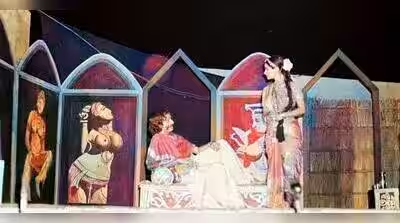
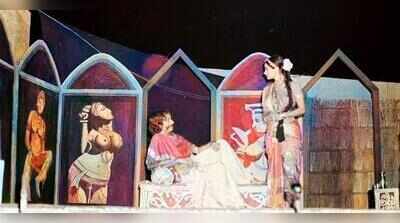
Patna: Long before theatre found a home in auditoriums and on proscenium stages, it belonged to the people of Bihar. Village squares, devotional gatherings and open spaces served as stages where music, dance, poetry and storytelling brought communities together. Rooted in regional languages and everyday experiences, these performances entertained audiences while reflecting their beliefs, struggles and aspirations.Jai Prakash, a theatre personality, traces an important strand of Bihar’s theatrical history to ‘Kirtaniya Natak’, a devotional performance tradition that developed across Bihar and neighbouring regions, including Bengal, Assam, Odisha and Nepal. Blending poetry, music and dramatic storytelling, it brought religious narratives within the reach of ordinary people.In Mithila, the devotional verses of Vidyapati helped shape this performance culture. ‘Brajbuli’, a literary language associated with Maithili and Bengali, featured in medieval devotional poetry devoted largely to Radha and Krishna. This close relationship between literature, music and performance laid the foundations of a distinctive regional theatrical tradition.Shiv Narayan Jha, a theatre personality, recalls a time when folk theatre was central to cultural life in Mithilanchal. Changing social and economic conditions, however, gradually weakened these traditions, pushing many towards decline.“The tradition of the theatre is more than 700 years old, but it had largely disappeared by the 20th century,” he said.Maithili theatre has a rich literary legacy, with figures such as Jyotirishwar Thakur, Siddhi Narasinghadeva and Bhupatindra Malla playing important roles in its history. Playwrights and theatre practitioners, including Munshi Raghunandan Das, Ishanath Jha, Prabodhnarayana Singh, Nachiketa, Sudhansu Sekhar Choudhary, Mahendra Malangia, Arvind Akku Gunanath Jha, Harijee and Ramjatan Mishra, helped sustain the tradition. Their work brought new themes to Maithili drama while keeping it rooted in the region’s language and cultural identity.When theatre became a mirror of societyBhojpuri theatre found its defining voice in Bhikhari Thakur, widely known as the Shakespeare of Bhojpuri. Drawing on rural life, he turned ordinary people’s experiences into compelling drama, tackling migration, poverty, caste divisions and social inequality.His celebrated play ‘Bidesiya’ portrayed families torn apart when men left their villages in search of work. Through songs, humour, dance and familiar characters, Thakur brought the emotional cost of migration to the stage. His work demonstrated how regional languages could carry powerful social messages through stories audiences recognised as their own.The tradition continued through artists who adapted folk theatre for changing times. The late Satish Anand and Sanjay Upadhyay were among those who reinterpreted Bidesia, connecting its traditional form with contemporary audiences.Suman Kumar, a veteran theatre personality associated with Doordarshan and productions such as Discovery of India, Bheem Bhawani and Mirza Ghalib, recalls a period when historical plays attracted artists from across the country. Productions such as ‘Surya ki antim kiran se surya ki pahli kiran tak’ and ‘Tughlaq’ broadened the theatrical landscape, he said. By the 1960s, plays such as ‘Adhe adhure’ were also being staged, bringing contemporary relationships and social concerns into focus.Kumar also highlighted the contributions of Satish Anand and Ganesh Prasad Sinha, along with theatre practitioners from Ara, Purnia and Chhapra. Yet, many artists eventually left Bihar in search of opportunities elsewhere.“The tragedy is that many of them moved to Delhi or Mumbai and settled there, and could not contribute to theatre in their own state,” Kumar said.Patna’s stages and a fading theatre movementPatna emerged as an important centre for modern theatre in Bihar, bringing together Hindi, Maithili and Bengali productions. Its auditoriums and cultural institutions gave playwrights and performers space to explore historical narratives, social inequalities and contemporary relationships. Kalidas Rangalaya and Vidyapati Bhavan became important venues for stage productions and regional-language performances.Bengali theatre, supported by the city’s Bengali community, added another dimension to its cultural life, while experimental productions widened the scope of artistic expression. But the movement has struggled to sustain its momentum. Kalidas Rangalaya has remained closed since 2025 for renovation, further limiting access to a major performance space.Migration, inadequate funding and limited institutional support have also weakened theatre groups. For young artists, the absence of regular performances and sustainable livelihoods makes it difficult to pursue theatre as a profession.Reviving Bihar’s theatrical legacy requires more than occasional festivals and tributes to celebrated playwrights. Folk performers need recognition and financial support, young artists need training and platforms, and regional-language productions need accessible venues and wider audiences.From Mithila’s devotional traditions to Bhikhari Thakur’s portrayal of migration and separation, Bihar’s theatre has preserved languages, challenged social hierarchies and given ordinary people a voice. Its strength has always lain in the ability to turn local experiences into stories that resonate far beyond the stage.The challenge is to keep those voices alive. Without sustained support, traditions that once brought communities together risk surviving only in memory. Bihar’s theatre has a remarkable past, but securing its future will require renewed commitment from artists, institutions and audiences alike.