








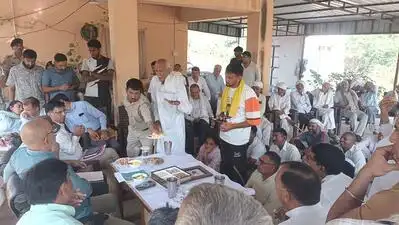
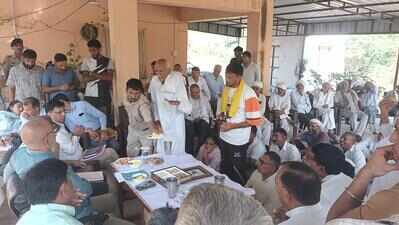
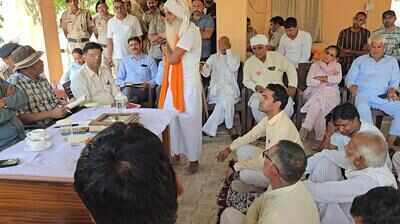
Gurgaon: A Supreme Court-appointed high-powered committee reviewing the definition and demarcation of Aravalis visited villages in south Haryana on Tuesday, where residents raised concerns over hill destruction, falling groundwater levels and illegal mining. Villagers in Mahendergarh’s Rajawas questioned the proposed auction of land notified as protected forest and demanded that the wider Aravali landscape be declared a conservation reserve.Brij Mohan Singh Rathore, former joint secretary in the Union environment ministry and a member of the five-member committee, and Prof Jagdish Krishnaswamy, dean of School of Environment and Sustainability at Indian Institute for Human Settlements in Bengaluru and a special invitee to the panel, visited Ramalwas in Charkhi Dadri and Rajawas in Mahendergarh. They held consultations with communities affected by mining and assessed local concerns linked to forest protection, groundwater depletion and ecological damage.The committee headed by director general of Indian Council of Forestry Research and Education is reviewing the definition of Aravali hills and ranges after concerns were raised over an earlier proposed definition based on hill elevation and the distance between hills. Environmental groups and local communities had feared that such a definition could exclude several ecologically significant areas from protection. SC has directed the committee to submit its final report by Nov 30, 2026.“We have been undertaking stakeholder consultations over the past couple of months. These involve two kinds of consultations — field visits, during which we reach out to villages and interact with local communities, and more structured consultations, which are held at district headquarters. This time, we had time, so during the field visits, we reached out to the communities and interacted with them. We are also conducting our own geospatial analysis of the terrain-based definitions, examining different polygons and how the proposed definition plays out on the ground,” a member of the committee told TOI.At Ramalwas, residents alleged prolonged quarrying had damaged hills, grazing commons and local biodiversity. They said mining below the groundwater table had caused nearby wells to dry up, while intense blasting led to cracks in several houses. Villagers also sought accountability for ecological losses and restoration of degraded mining sites.Sanju, sarpanch of Ramalwas, said the village’s mining lease was terminated towards the end of 2024, but the gram panchayat had not received its mandated annual revenue share or lease rent since 2018. He sought payment of dues, compensation for environmental damage and conversion of mining craters into rainwater recharge structures.In Rajawas, residents objected to proposed mining of 119.6 acres of land, which they said was part of 506 acres notified as protected forest by Haryana govt on June 20, 2023, under the Indian Forest Act, 1927. Mohit, sarpanch of Rajawas, told TOI that the mining land was listed for e-auction on the same day the protected forest notification was issued, without the knowledge or consent of the gram panchayat. “We want protection for wider Aravali landscape as there is threat from mining to forests, groundwater and agriculture.”TOI had earlier reported on the auction of the protected Aravali land. National Green Tribunal later took suo motu cognisance and issued notices to the Union environment ministry and others.Residents told the committee that groundwater levels in the region declined sharply and that mining posed a threat to agriculture and wildlife habitats. “We have sought protection for a contiguous Aravali landscape spanning around 15km and covering more than 20 villages. We want the area to be declared a conservation reserve, as there is presence of wildlife, including leopard, striped hyena, porcupine and monitor lizard,” said Mohit.Villagers also raised concerns over mining and stone crushing in neighbouring Ushmapur, alleging these activities were affecting forests, air quality, crops and groundwater. Neelam Ahluwalia, co-founder of Aravali Virasat Jan Abhiyaan, urged the committee to recommend a ban on mining in groundwater-stressed areas, cancellation of leases where operators mine beyond approved boundaries or violate groundwater restrictions, and a cumulative environmental, social and public health assessment of damage caused by mining, stone crushing, cement plants and waste dumping across the Aravalis.