











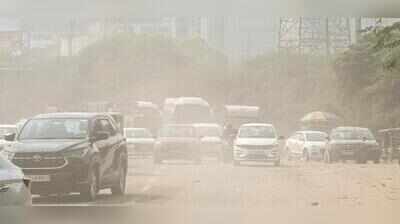
Gurgaon: The city recorded its cleanest Oct air since monitoring began in 2016, with the average air quality index (AQI) falling to 162 this year. The improvement came amid excess rainfall during the month and absence of firecracker emissions as Diwali falls in Nov this year.The Oct average AQI was nearly 15% lower than 190 (moderate) recorded in 2025. It was also below 165 (moderate) recorded in 2024 and 183 (moderate) recorded in 2023. Compared with 2022, when the monthly average stood at 202 (poor), this year’s reading was 20% lower. The AQI was marginally lower than 164 (moderate) recorded in 2021 and 35% lower than 248 (poor) recorded in 2020. It was 22% below the 2019 average of 207 (poor), 39% lower than 265 (poor) recorded in 2017, and 50% lower than 325 (very poor) recorded in 2018. The 2016 average was 176 (moderate), about 8% higher than this year’s reading.The city began recording air quality data in 2016, when it had only one monitoring station. The network gradually expanded and reached four stations by 2019. This expansion is important while comparing historical AQI trends, as data from a single station may not represent pollution levels across the city. However, even when the comparison is limited to 2019 onwards, Oct 2026 recorded the lowest average AQI in eight years, indicating that the improvement cannot be attributed only to a wider monitoring network.The city recorded six days of poor air quality this Oct, compared with 15 in Oct 2025. There were no days in the very poor or severe categories.Manoj Kumar, an air analyst at Centre for Research on Energy and Clean Air (CREA), said favourable weather conditions and the timing of Diwali may have contributed to the improvement. “Gurgaon’s AQI was relatively lower this Oct, partly due to excess rainfall, which helps wash pollutants out of the air, and the absence of firecrackers, as Diwali falls in Nov this year,” he said.Daily readings showed fluctuations through the month. The first 10 days recorded an average AQI of around 182, which improved to nearly 135 between Oct 11 and 20. The improvement, however, did not continue through the final stretch. AQI rose to 240 on Oct 29 before dropping sharply to 69 on Oct 30 and 83 on Oct 31.Of the 31 days, 22 recorded moderate AQI, three were in the satisfactory category and six fell in the poor category. The city did not record a single day in the good category.Despite the improvement, road dust remains a major concern. Broken roads, unpaved stretches and construction debris add to the particulate load. Vehicles moving over these stretches lift settled dust into the air, while repeated traffic movement keeps particles suspended and exposes residents to higher levels of particulate matter. Heavy traffic on damaged roads, along with the lack of proper paving and regular mechanical sweeping, further worsens the problem.The AQI scale classifies readings between zero and 50 as good, 51 and 100 as satisfactory, 101 and 200 as moderate, 201 and 300 as poor, 301 and 400 as very poor, and 401 and 500 as severe. According to CPCB guidelines, moderate AQI can cause breathing discomfort to people with lung disorders, asthma and heart disease.The coming weeks will indicate whether the relatively better air quality recorded in Oct can be sustained as temperatures fall and seasonal pollution sources intensify.